The marketing industry runs on creativity, lateral thinking, and the ability to see things differently. So it’s worth asking: are you building teams that actually allow different kinds of minds to do their best work?
Around one in five people in the UK are neurodivergent – that includes ADHD, autism, dyslexia, dyspraxia, and more. In a creative industry like marketing, that’s not a challenge to manage. It’s a competitive advantage – if you know how to unlock it.
As the ADHD and autism experts at RTN Mental Health Solutions explain, neurodivergent thinking can bring a wealth of benefits to a marketing team, and you can quite easily build an environment where it thrives.
Hyperfocus is a valuable tool
One of the hallmarks of ADHD is the ability to hyperfocus: to lock onto a problem or project with extraordinary intensity and produce work in a concentrated burst that would take others days. For a copywriter, strategist, or designer, this can be the difference between good work and exceptional work.
The catch with hyperfocus is that it’s easily broken. Constant Slack notifications, back-to-back meetings, and open-plan offices that treat noise as a sign of productivity are all kryptonite for deep focus.
If you want this kind of output from your team, protect the conditions that make it possible. That means async communication where possible, meeting-free blocks in the calendar, and ditching the assumption that someone with headphones in isn’t working hard enough.
Neurodivergent thinkers spot what everyone else has stopped seeing
Pattern recognition, obsessive attention to detail, and the ability to hyperfixate on a niche topic are all traits commonly associated with autism and ADHD. In marketing, these translate directly into skills: spotting a gap in a competitor’s content strategy, identifying why a campaign isn’t converting, or going so deep on a client’s industry that the brief almost writes itself.
The neurodivergent team member who spends three hours reading everything ever written about a client’s sector isn’t going off-script – they’re doing some of the most valuable research on the team.
The mistake many agencies make is confusing this depth of thinking with inefficiency or misplaced focus. The better approach is to build roles and workflows that make space for it.
Psychological safety as a performance driver
Neurodivergent employees often mask: they adapt their natural behaviour to fit neurotypical expectations. The important thing to understand is that this is exhausting and ultimately unsustainable. What’s more, if their masking becomes the norm for them in the workplace, you may actually be losing the very thing that makes them valuable in the first place.
The antidote is psychological safety – an environment where people can work in the way that suits them without fear of judgement. That might mean flexibility on when and where work gets done, clear and consistent communication from leadership, and a culture where someone can say “I’m not functioning well today” without it being held against them.
Agencies that build psychologically safe teams retain their best people longer, see higher quality output, and spend less time and money on recruitment. It’s good business.
Clear briefs are essential
Ambiguity is expensive. For neurodivergent team members, unclear expectations aren’t just frustrating – they can be genuinely paralysing. A brief that leaves too much open to interpretation, a feedback email that says “can you just make it pop more”, or a moving deadline that nobody communicates – these things create friction that kills momentum.
The good news is that fixing this benefits everyone. Clear briefs, specific feedback, and predictable processes make for better work across the board. If you wouldn’t know how to brief a neurodivergent team member clearly, you probably aren’t briefing anyone clearly enough.
Different minds, better campaigns
The best marketing doesn’t come from a room full of people who think the same way. It comes from teams that bring genuinely different perspectives – and have the structure in place to channel them effectively.
Neurodivergent thinking isn’t a niche consideration for inclusive employers. It’s a direct input into the quality of your creative output, your strategic thinking, and your client results. Agencies that understand this – and build for it – don’t just do the right thing. They do better work.
You are getting traffic. People are landing on your site. And then, largely, they are leaving.
No enquiry. No purchase. No call booked. Just a bounce rate that makes for uncomfortable reading and a cost-per-click that feels increasingly hard to justify.
This is one of the most common problems we see when working with new clients, and the good news is that it is rarely a mystery. Websites that don’t convert tend to fail for the same handful of reasons we see all the time, and most of those reasons are fixable without a full redesign, a new brand, or months of extra development work.
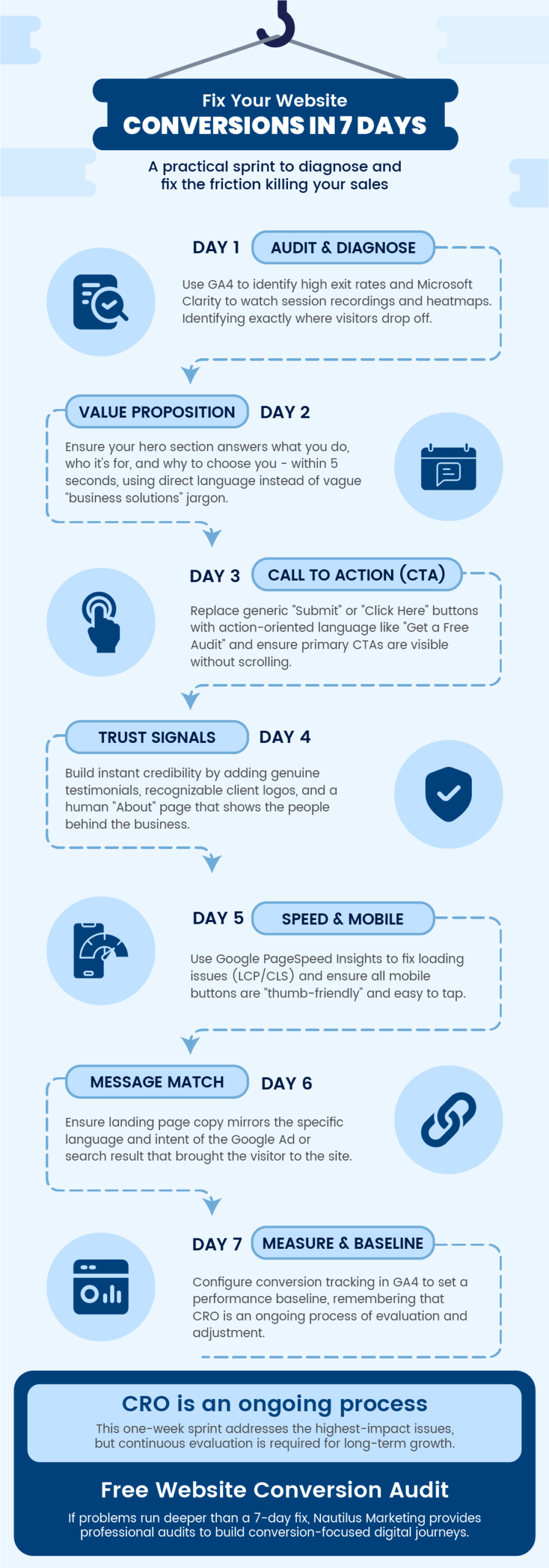
This guide aims to give you a practical, day-by-day plan to diagnose what is wrong and start fixing it. Seven days, one priority focus each day, and a meaningfully better-performing site by the end of it.
Why most websites fail to convert
Before getting into the fix, it helps to understand the problem clearly. A poor conversion rate for a website is almost never caused by a single factor. It is usually a combination of issues that in isolation seem minor, but collectively they create enough friction to kill the action you want the visitor to take.
The most common culprits are a weak or unclear value proposition, slow load times, a poor mobile experience, messaging that does not match what brought the visitor to the site in the first place, a lack of trust signals, and calls to action that are either missing, buried, or unconvincing.
Google’s research into page experience and user behaviour consistently shows that friction at any point in the user journey, whether that is speed, clarity, or trust, directly reduces the likelihood of conversion.
In our experience auditing sites for clients across a range of industries, the single most common issue is not technical at all. It is that the page does not clearly answer the question a visitor arrives with: why should I choose you, and what do I do next? Everything else is secondary to getting that right. In the realm of AI and the changing search landscape, this task is more important than ever!
The 7-day conversion fix plan
This plan is built around the highest-impact changes you can make in the shortest amount of time. It is not a complete redesign. It is a focused ‘sprint’ that addresses the issues most likely to be costing you conversions right now.
Day 1: Audit what you actually have
You cannot fix what you have not diagnosed. Day one is about understanding where visitors are dropping off and why.
Set up or review your Google Analytics 4 data carefully to identify which pages have the highest exit rates and where in the journey people are leaving. If you have heatmap or session recording data from a tool like Microsoft Clarity, which is free, use it! Watching real users navigate your site is one of the most revealing things you can do.
Ask yourself three questions about your most important pages. Is it immediately clear what this business does and who it is for? Is there an obvious next step for the visitor? And does the page give someone enough reason to take that step?
Microsoft Clarity is a free behaviour analytics tool that provides heatmaps, session recordings and user flow data without any sampling.
Write down the three pages most likely to be losing you conversions. Those are your priorities for the rest of the week.
Day 2: Fix your value proposition
If a visitor can’t tell within five seconds what you do, who you do it for, and why you are the right choice, you have a value proposition problem. This is the single most common conversion killer we encounter, and it is also the one most businesses underestimate.
Your homepage hero section and the top of every key landing page should answer three things immediately: what you offer, who it is for, and what makes you worth choosing over the alternatives (why you?).
Vague headline language like “solutions for your business” or “taking your brand to the next level” does not do this. Specific, honest, direct language does. The goal is always to resonate with your audience and their pain points. “SEO and paid media for UK businesses that want more from their digital marketing” is more useful than any amount of clever positioning.
Rewrite your headline and subheading on your two or three most important pages today. Keep it clear, keep it specific, and resist the temptation to be clever at the expense of being understood.
Day 3: Sort your calls to action
A call to action is not just a button. It is the moment where intent becomes action, and most websites handle it poorly.
Common CTA problems we see all the time include buttons that say “submit” or “click here” rather than something meaningful, CTAs that are buried below the fold, pages with too many competing actions, and landing pages where the primary action is not obvious on first glance.
Today, go through your priority pages and make sure every one has a single, clear primary CTA that is visible without scrolling, uses specific action-orientated language, and stands out visually from the rest of the page. “Get a free audit”, “book a call”, and “see our work” are all more compelling than “contact us” or “learn more”. If a page has multiple CTAs, decide which one matters most and make that the dominant one. The others can stay, but the hierarchy needs to be clear.
*Additional Tip: Colour contrast is easily overlooked; this means your CTA is simply overlooked. It would definitely be worth your while to use a free tool like Accessible Web to double-check that this isn’t the case – it’s free and can be added to your Chrome as an extension.
Day 4: Improve your trust signals
People do not convert on sites they do not trust. Trust is built through a combination of signals, and most of them are straightforward to add or improve.
Check that your site has the following: genuine client testimonials with names and ideally company or role details, case studies or results If you have them, recognisable logos of clients or partners where appropriate; a clear and human about page that shows the people behind the business; and visible contact details, including a phone number or address where relevant.
If you are running paid traffic to landing pages in particular, trust signals become even more critical. A visitor who arrives from a Google Ad has never heard of you. The page has seconds to establish enough credibility to keep them engaged.
Research into trust signals and conversion rates consistently shows that social proof, including reviews, testimonials and case studies, is among the highest-impact elements on any conversion-focused page.
Day 5: Check your page speed and mobile experience
This one is technical but non-negotiable. A slow site loses conversions before the visitor has even read a word, and a poor mobile experience in a world where the majority of web traffic is on mobile is simply not acceptable.
Run your key pages through Google PageSpeed Insights, which is free, and note any issues flagged as high priority. Pay particular attention to Largest Contentful Paint, which measures how quickly the main content loads, and Cumulative Layout Shift, which measures whether the page jumps around as it loads.
On mobile, check that buttons are large enough to tap easily, that text is readable without zooming, that forms are simple to complete on a small screen, and that nothing important is hidden or broken. – It’s all about user experience here; reduce the friction.
Google PageSpeed Insights gives you a free, instant performance report for any URL and includes specific recommendations for improvement.
You may not be able to fix everything today, but identify the biggest issues and prioritise them for your development resource.
Day 6: Match your messaging to your traffic source
One of the most overlooked conversion problems is message mismatch. This happens when the language, offer, or tone of a landing page does not match the ad, search result, or link that brought the visitor there.
If someone clicks a Google Ad for “web design for small businesses” and lands on a generic homepage that talks about enterprise solutions, they will leave. The expectation set by the ad and the experience delivered by the page needs to be consistent. – This will affect your Ad Rank.
Go through your key traffic sources today and check whether the pages they land on match the intent and language of the source. If you are running paid campaigns, every ad group ideally needs a landing page that mirrors its specific message. If your SEO traffic is landing on pages that do not match the search intent of the keywords driving that traffic, that is a problem worth fixing.
This is an area where SEO, paid media and web design genuinely need to work together. A great ad sending traffic to a mismatched page is wasted budget, and it is a pattern we see more often than we should.
Day 7: Test, measure, and prioritise what is next
By day seven you would have made meaningful improvements across value proposition, CTAs, trust signals, speed, and message alignment. Today is about setting yourself up to keep improving.
Make sure your conversion tracking is properly configured in Google Analytics 4 and, if relevant, Google Ads. You need to be able to see which pages and traffic sources are converting and which are not, at a granular level. Without this data, you are optimising blind.
Set a baseline for your key conversion metrics today so you can measure the impact of the changes you have made over the coming weeks. Conversion rate optimisation (CRO) is not a one-week project. It is an ongoing process of evaluation and adjustment. What this week has done is address the most common and highest-impact issues so you have a stronger foundation to build from.
What to do if the problems run deeper
Sometimes a seven-day sprint surfaces issues that go beyond quick fixes. If your site has fundamental structural problems, a poor information architecture, a brand that does not reflect the quality of your actual work, or landing pages that were never built with conversion in mind, those require more considered attention.
In our work with clients on web design and landing page builds, the most successful projects are those where conversion is built into the brief from the start rather than retrofitted afterwards. A well-designed page that is clear, fast, trustworthy, and structured around what the visitor needs is not just better for users. It performs measurably better across every traffic source.
Conclusion
Most websites do not fail because of one dramatic problem. They fail because of several small ones that add up to a visitor experience that does not earn the conversion. The good news is that those problems are findable, fixable, and in most cases do not require starting from scratch.
If you work through this plan and find that the issues run deeper than a week of focused fixes can address, or if you want a proper audit and a clear plan for what to do about it, the Nautilus team is always happy to take a look.
Getting into e-commerce is a particularly attractive business opportunity for entrepreneurs. By 2024, 21.24% of total retail sales will be online. And the market shows no signs of slowing. Globally, the e-commerce industry is projected to grow at 14.3% CAGR (2021-2030), reaching 1.9 trillion USD by 2030.
There are different e-commerce platforms to host your online store, such as Amazon, WooCommerce, and Shopify. Shopify is a top 5 e-commerce platform with over 4.4 million live sites worldwide and over 180 thousand live UK sites. It’s a popular platform that, according to Forbes, is ‘shifting’ the e-commerce landscape.
Shopify stores offer entrepreneurs low start-up costs, easy-to-use functionality, and a built-in payment gateway. Perhaps you’ve considered starting your own Shopify store or are currently doing so. You’re in the right place if you want a comprehensive guide to Shopify costs in the UK.
The blog covers DIY and professional store build costs and ongoing expenses, including Shopify fees and effective money-saving strategies.
Table of Contents
What is Shopify and How Does it Work?
Benefits of Shopify for E-commerce Entrepreneurs
Shopify Store Costs (UK)
Which Shopify Pricing Plan is Best for My Business?
Other Shopify Costs
Expert Shopify Store Setup vs DIY Build
Cost-Effective Strategies
Partner with a Shopify Expert Today
FAQs
What is Shopify and How Does It Work?
Shopify is an e-commerce platform enabling individuals and businesses to set up and run online stores. Founded in 2006, Shopify has quickly become one of the most popular user-friendly solutions for entrepreneurs looking to sell products or services online. The platform provides a range of features, including customisable website templates, secure hosting, payment processing through Shopify payments or other gateways, and tools for managing products, inventory, and customer orders.
Shopify is designed to be accessible to users with varying technical expertise, making it an attractive option for startups, small businesses, and established enterprises. It also offers scalability, allowing businesses to grow and expand their online presence. In addition, Shopify has an extensive App Store where users can easily integrate third-party apps for enhanced functionality.
Benefits of Shopify for E-Commerce Entrepreneurs
Shopify is an invaluable all-in-one platform, offering many benefits for businesses venturing into online retail. As a website builder and e-commerce solution, Shopify streamlines the entire process of setting up and managing an online store. One of its notable advantages lies in the provision of Shopify payments, its native payment gateway, which simplifies transactions and eliminates the need for third-party services. This feature ensures a seamless payment process and often reduces transaction fees.
Furthermore, Shopify’s versatility extends to its user-friendly interface, allowing effortless integration of third-party apps for enhanced functionality. Entrepreneurs can easily tailor their online stores to meet specific business needs, from marketing and analytics tools to customer service and inventory management. This adaptability makes Shopify ideal for businesses seeking a comprehensive and flexible e-commerce solution.
Top 10 Benefits of Shopify Stores
User-Friendly Platform
All-in-One Solution
Native Payment Gateway
Mobile Responsive
SEO-Friendly Features
Extensive App Store
Secure Hosting
Scalability
International Sales Support
Dedicated Support and Resources
Shopify Store Costs (UK)
Setting up a Shopify store comes with various costs that every entrepreneur should know to ensure a successful and sustainable e-commerce venture.
Breakdown of the Costs Involved
Understanding the components of Shopify costs is key to smart money management. It’s like having a roadmap for your finances, helping you make savvy decisions and avoiding any surprise bumps along the way.
The primary costs include:
Subscription Plans
Shopify offers different subscription tiers (Basic, Shopify, Advanced Shopify, Shopify Plus), each with its own features and pricing structure. Choosing the right plan depends on the scale and needs of your business (we will go into more detail on this shortly).
Shopify Transaction Fees
While Shopify payments reduce or eliminate transaction fees, external payment gateways may incur additional charges. Make sure you give the terms and conditions a good look to understand when and how these fees apply to avoid any surprises.
Third-party App Expenses
Integrating third-party apps can elevate your Shopify store’s functionality. Still, it’s important to note that they may have associated costs. Therefore, you should be mindful and choose apps that align with your business goals and your budget.
Shopify Theme Costs
Shopify offers both free and premium themes. There are 80 themes, 9 of which are free to use. The others are paid and cost around £110 – £140.
Additional Costs
Miscellaneous expenses such as domain registration fees, marketing, and potential unforeseen costs should be factored into your budget.
The Importance of Understanding Shopify Costs Before Setting Up a Store
Before you dive into the exciting world of Shopify, you must understand the ins and outs of the costs involved. Having a clear understanding upfront will ensure your budget is well allocated and you steer clear of any surprise bumps in the road.
Which Shopify Pricing Plan is Best for My Business?
Shopify fees vary depending on the plan you choose.
There are four plans available:
Shopify Starter
Basic Shopify
Shopify
Advanced Shopify
Shopify Starter (£5/month)
Ideal for those with limited time for coding or design, this simple option provides a hassle-free entry into e-commerce.
Basic Shopify (£19/month billed annually)
Tailored for small businesses with low monthly sales, it offers basic reports, multiple reporting locations, and two staff accounts.
Shopify (£49/month billed annually)
Perfect for growing and international businesses, this plan provides powerful reporting tools and the ability to optimise international SEO with country-specific domains.
Advanced Shopify (£259/month billed annually)
This plan is designed for large online stores with international reach. It offers a custom report builder, lower credit card rates, and third-party calculated shipping rates.
For a more in-depth breakdown of each plan refer to this Shopify costs guide.
Other Shopify Costs
Running a Shopify store involves more than just subscription plans. Various other costs come into play, including transaction fees, payment gateway fees, third-party app expenses, theme costs, and additional costs.
Shopify Transaction Fees
In the UK, Shopify transaction fees are determined by the payment methods your customers use during checkout. Suppose you opt for Shopify Payments, the platform’s default method. In that case, you’ll incur a variable fee ranging from 2% to 1.5%, depending on your Shopify plan, along with a flat fee of 25p. The transaction fee decreases the more advanced plan you are on:
Basic 2.0%
Shopify 1.0%
Advanced 0.5%
Shopify Payment Gateway Fees
Shopify’s best payment gateway options include Shopify Payments, Payments, Stripe, Amazon Pay, Klarna, and Shop Pay. Shopify Payments is the platform’s built-in payment gateway, eliminating the need for external providers and offering seamless integration with primary payment methods. It provides a native interface within the Shopify admin panel for managing orders, payments, and payouts. Payments are typically processed within three business days, with card fees varying based on the merchant’s Shopify plan: 2.2% + £0.20 for Basic, 1.9% + £0.20 for Shopify, and 1.6% + £0.20 for Advanced Shopify, with no hidden costs.
Third-Party App Expenses
From marketing tools to inventory management, each app comes with its unique features and associated costs. Be sure to check each third-party’s website to get the most up-to-date costings.
Selecting a suitable Shopify theme is pivotal in creating an online store that looks good and functions seamlessly. Shopify provides a range of themes, with a selection of 80. Among these, nine are available for free, while the remaining premium themes come at a cost ranging somewhere between £110 and £140. It’s essential to weigh the benefits of each based on your business needs.
For inspiration, check out some of the best e-commerce sites on Shopify’s blog.
Additional Costs
Beyond the core expenses, additional costs exist to factor into your Shopify venture. Firstly, consider domain name registration fees (approx. £10-£15), crucial for establishing your brand identity online. Set up a professional business email if you haven’t already, i.e., @yourbrandname.com, not @gmail.com. Budgeting for marketing and advertising is equally important to drive traffic and boost sales (contact Nautilus Marketing for a bespoke quote). Additionally, be mindful of potential miscellaneous expenses, such as unforeseen technical needs or operational costs.
Expert Shopify Store Setup vs DIY Build
When setting up your Shopify store, choosing between expert assistance or going the DIY route depends on your specific needs and resources. If you’re a startup with a limited budget, Shopify’s user-friendly interface allows you to DIY your storefront. However, if you have more money to play with, enlisting the expertise of professionals can be invaluable and save you a lot of hassle.
At Nautilus Marketing, our expert team offers tailored solutions with costs starting at around £3,500 – £4,000 for a store build. A Shopify build by Nautilus ensures a seamless and customised storefront that aligns with your business goals. Whether you’re looking to DIY or partner with our nerds, the key is finding the approach that best suits your objectives and budget.
Cost-Effective Strategies
Let’s talk about stretching those pounds when setting up your online store.
Here are a few nifty tips to keep your Shopify costs down and your value up:
1. Make Price-Smart App Choices
Look out for free or reasonably priced app integration options to add greater functionality without breaking the bank.
2. Clear and Concise Product Categories
Ensure your product categories are clear and concise so customers can easily find what they are looking for. Doing so ensures your store looks good, doesn’t turn away buyers, and saves you cash too.
3. Budget-Friendly Themes:
Fancy Shopify themes can be cool, but let’s not overspend. Many free and budget-friendly themes will work just fine and still offer a pleasing aesthetic charm.
Partner with a Shopify Expert Today
Establishing and running a successful e-commerce store involves more than just picking a template and adding products. It’s about understanding Shopify costs, selecting the right pricing plan tailored to your business needs, and leveraging the benefits of Shopify’s all-in-one platform. Whether you’re a startup or an established brand seeking growth, the scalability and flexibility of Shopify, especially when coupled with expert guidance, can truly take your business to the next level.
That’s where Nautilus Marketing comes in – your Shopify secret weapon. We don’t just talk the talk – we walk it with you, ensuring your Shopify store is set up for success. Here’s to your thriving online store!
Ready to take your Shopify experience to the next level?
Digital platforms compete for attention, yet attention alone does not lead to loyalty. Users expect reliability, clear communication, and consistent value before they return. Trust shapes each interaction, from first visit to long-term use. Without it, even strong marketing efforts struggle to convert interest into ongoing engagement.
Retention follows when platforms meet expectations at every step. Users notice how systems perform, how issues are handled, and how transparent a service feels. Strong platforms focus on steady improvements and clear user benefits, rather than short bursts of activity.
Trust as the Foundation of Digital Engagement
Trust grows through clarity and consistency. Users want to know who they are dealing with, how their data is handled, and what they can expect from the service. Clear policies, visible licensing, and honest messaging all help reduce doubt.
Simple actions make a difference. Display security badges where users make payments. Keep terms easy to read. Offer straightforward explanations about data use rather than dense legal text. These details show respect for the user’s time and concerns.
Reviews also influence perception. Encourage verified feedback and respond to it. A thoughtful reply to criticism often builds more credibility than a perfect rating. Platforms that engage openly tend to hold user attention for longer.
Consistency matters just as much. A platform that performs well one day and fails the next quickly loses trust. Regular testing and maintenance ensure that users feel confident returning without hesitation.
User Experience and Platform Reliability
Ease of use often determines how long someone stays on a platform. Complicated layouts or slow load times create friction that pushes users away. Clear navigation helps users find what they need without effort.
Design should guide behaviour without confusion. Buttons need clear labels. Pages should load quickly, even during busy periods. Mobile access is equally important, as many users switch between devices throughout the day.
Reliable performance builds confidence. When users know a platform works smoothly every time, they are more likely to return. Technical stability is not something users praise often, yet they notice it immediately when it fails.
Testing plays a key role here. Regular audits of site speed, broken links, and functionality help maintain a consistent experience. Small improvements, such as reducing page load time, can lead to better customer retention over time.
Personalisation and Relevant Content Delivery
Personalisation helps users feel that a platform understands their needs. Data allows platforms to tailor content, yet it must be handled with care. Users appreciate relevance, though they expect privacy to be respected.
Offer custom dashboards or suggested content based on previous activity. Keep these features simple and easy to adjust. Giving users control over their preferences builds trust and improves engagement.
Avoid overwhelming users with too many recommendations. A focused selection often performs better than endless suggestions. Relevance matters more than quantity.
Communication also benefits from personalisation. Emails, alerts, and updates should reflect user interests without becoming intrusive. Balanced messaging keeps users informed without causing frustration.
Incentives, Rewards, and User Motivation
Incentives encourage users to return, especially when they feel fair and easy to access. Loyalty schemes, exclusive offers, and timed promotions can increase activity without overwhelming users.
Clarity is key. Users need to understand how rewards work and what they gain from participating. Confusing terms reduces interest and can damage trust.
Online entertainment platforms often rely on structured incentives to maintain engagement. For example, some users may choose to try their hand at UK sports betting at BoyleSports, where clear offers and accessible features contribute to ongoing participation.
Consistency across promotions helps reinforce user confidence. Sudden changes or unclear rules can lead to frustration. Platforms that keep incentives straightforward tend to see stronger engagement over time.
Social Proof and Community Influence
People often look at others before making decisions. Reviews, ratings, and shared experiences influence how a platform is perceived. Positive feedback builds confidence, while visible responses to criticism show accountability.
Encourage users to share their experiences. Highlight genuine testimonials rather than polished marketing statements. Authenticity resonates more with audiences.
Community features can also strengthen engagement. Forums, comment sections, or shared insights give users a sense of involvement. This interaction adds value beyond the core service.
Transparency remains important here. Display both positive and negative feedback where appropriate. Users trust platforms that show a balanced view rather than hiding criticism.
Ongoing Communication and Customer Support
Strong communication builds lasting relationships. Users expect quick answers when problems arise. Delayed responses often lead to frustration and lost trust.
Offer multiple support channels such as live chat, email, and help centres. Each option should be easy to access without searching through multiple pages.
Clear communication extends beyond support. Regular updates about changes, improvements, or maintenance schedules keep users informed. This reduces confusion and sets expectations.
Tone also matters. Responses should feel human and direct, avoiding overly scripted language. A helpful reply can turn a negative experience into a positive one.
Tracking common issues helps improve service quality. When platforms act on feedback, users notice the effort and are more likely to stay engaged.
Adapting to Changing User Expectations
User behaviour shifts over time. Platforms that stay static often struggle to maintain interest. Regular updates keep services relevant and aligned with user needs.
Feedback provides valuable insight. Surveys, usage data, and support queries reveal what users want and where improvements are needed. Acting on this information helps refine the overall experience.
Technology also plays a role. Faster connections, new devices, and evolving habits all influence how users interact with platforms. Keeping up with these changes ensures continued engagement.
Flexibility is important. Small, regular updates often work better than large, infrequent changes. Users appreciate steady improvements that enhance usability without disrupting familiar features.
Strengthen User Retention
Strong digital platforms focus on consistency, clarity, and user value. Trust grows when users feel secure and supported at every stage of their journey. Reliable performance, thoughtful communication, and fair incentives all contribute to long-term engagement.
Review your current approach and identify areas where users may face friction. Small adjustments can lead to noticeable improvements in retention. Focus on delivering a dependable experience that users feel confident returning to again and again.
Standard SEO advice works well enough in low-competition markets. Build a clean site, produce relevant content, earn a few links, and rankings will follow. But in saturated verticals — legal, finance, insurance, online gambling — that approach is essentially useless. The players already occupying those top positions have been investing heavily for years, and catching up requires a fundamentally different mindset.
The gap between first and second is not marginal. It is structural. Businesses that fail to recognise this continue pouring budget into tactics that deliver diminishing returns, while their competitors pull further ahead.
What High-Stakes Industries Reveal About SEO Spend
Industries with the highest commercial stakes per visitor spend disproportionately on SEO because the return justifies it. Online gambling is a useful illustration of how far this investment extends. The sector competes fiercely for organic visibility across thousands of highly commercial terms, and according to Gambling Insider there are dozens of excellent sites for players to choose from. The UK slot site market alone represents one of the most aggressively optimised digital categories in existence. That level of competition forces continuous innovation in link building, content architecture, and technical SEO — strategies that translate directly into lessons for legal, finance, and insurance brands facing comparable pressure.
The global SEO market reached $92.74 billion in 2025, with a projected 16.8% compound annual growth rate — figures driven largely by demand from exactly these high-stakes verticals. The spend reflects the stakes.
Why Competitive Niches Break Standard SEO Rules
Search in high-competition verticals has become increasingly hostile to newcomers. Position one on Google captures 27.6% of clicks, while page two receives just 0.63% — a gap so dramatic that anything outside the top three results is, for practical purposes, invisible. In niches where every click represents significant commercial value, this concentration of traffic makes standard optimisation insufficient.
Compounding this, the rise of AI Overviews has reshaped the competitive landscape further. Position one Google results see a 34.5% lower click-through rate when AI Overviews are present, meaning even businesses that rank first now receive materially fewer visitors than they did two years ago. Competing in this environment demands more than good content — it demands a data-led, precision strategy built around real search behaviour.
The Tactics That Actually Move Rankings
Businesses in saturated markets need to focus on three areas where standard SEO typically falls short: technical authority, content depth, and link acquisition at scale. Technical performance matters more here because margins are thin — slow load times and poor Core Web Vitals directly affect rankings when competitors are otherwise equally matched.
Content depth is equally non-negotiable. Thin articles targeting broad terms will not rank against established players producing comprehensive resources backed by genuine topical authority. High-competition niches reward specificity, structured data, and content that directly answers commercial intent queries. Generic strategies built around keyword volume alone routinely fail here.
Building a Long-Term Edge in Saturated Markets
Sustainable visibility in competitive niches requires compounding advantages, not one-off campaigns. Businesses that treat SEO as a continuous investment — iterating on technical performance, expanding content authority, and building editorial links at scale — create a compounding lead that becomes increasingly difficult for competitors to close.
The zero-click search crisis adds urgency to this. Over half of all Google searches now end without a site visit, which means organic rankings must deliver higher-quality traffic, not just more of it. Brands that optimise for conversion alongside rankings are the ones that see durable returns. In high-competition verticals, aggressive strategy is not optional — it is the only viable path to meaningful, sustained visibility.
Small businesses manage daily call volumes with limited teams. Every unanswered call risks lost revenue and weakens a company’s first impression. Many firms cannot justify the salary of a full-time receptionist, yet the cost of missed calls accumulates quickly. Some callers do not try again after reaching voicemail. Each missed enquiry may represent a lost opportunity.
AI-powered receptionist services provide an alternative. These systems answer calls at any hour, collect essential details, and route enquiries without increasing payroll costs. More small firms are adopting AI reception tools to meet rising expectations for speed and availability. An automated system maintains a consistent and professional response for every caller, regardless of time or workload.
The Hidden Cost of Missed Business Calls
Customers expect prompt responses. When calls go unanswered, many contact a competitor. In sectors such as legal services, property, trades, and healthcare, a single missed call can represent substantial long-term revenue. Small teams often underestimate how frequently calls are lost during peak periods.
AI receptionist technology addresses this operational gap. Calls no longer ring out during busy hours or after closing time. The system responds immediately and provides consistent, accurate information. For business owners exploring this option, how an AI receptionist handles business calls demonstrates how enquiries are automatically answered, filtered, and directed to the right person without manual intervention.
Lunch breaks, staff meetings, holidays, and sickness all create coverage gaps. Many callers no longer leave voicemail messages. Delayed follow-up reduces trust and lowers conversion rates. Responding quickly to new enquiries increases the likelihood of securing the client. Businesses that answer first often win the work.
Modern Call-Handling Solutions for Resource-Constrained Businesses
Traditional solutions include call forwarding or part-time reception staff. Call forwarding relies on someone being available to answer. It does not remove pressure during busy periods. Hiring human virtual reception services introduces flexibility, but costs increase as call volumes grow.
AI receptionist systems operate continuously. They answer every call within seconds, regardless of time or internal workload. Using natural language processing, the system identifies caller intent and directs the call appropriately. This may involve transferring urgent enquiries, booking appointments, capturing contact details, or providing pre-approved information.
Adoption continues to increase across UK small businesses seeking predictable service standards. AI systems deliver consistency without being affected by holidays, illness, or unexpected spikes in demand. This reliability reduces operational stress and strengthens customer confidence.
Automated call handling also creates structured records of interactions. Businesses gain visibility into call patterns, enquiry types, and peak demand periods. These insights support better resource planning and service improvements without expanding staff numbers.
Implementing an AI Call System in Your Small Business
Implementation begins with reviewing existing call data. Track daily volumes, peak hours, and frequently asked questions. Identify when calls are missed and where bottlenecks occur. This analysis helps define how the AI system will manage enquiries.
Integration is typically straightforward. Calls route through an existing business number or cloud-based telephony platform. Setup includes configurable greetings, routing logic, and escalation rules. Managers can define conditions under which calls transfer to a mobile device or internal team member. Routine enquiries can be handled automatically.
Clear communication with staff supports effective adoption. Define which enquiries the AI manages and which require direct human involvement. This prevents confusion and ensures consistent customer experience. Teams often find they spend less time on repetitive calls and more time on revenue-generating work.
Technical requirements are minimal. A stable internet connection supports most UK office environments. No additional hardware is generally required, and configuration can be adjusted as business needs evolve.
Measuring Success and Return on Investment
After deployment, performance should be monitored using measurable indicators. Missed-call rates typically decline significantly. Businesses typically achieve consistent call coverage once automated systems are active.
Compare this improvement with the annual cost of hiring a full-time receptionist. Salary, pension contributions, and employment overheads can exceed £30,000 per year, particularly amid rising labour costs for small businesses. AI receptionist solutions usually operate on predictable monthly pricing models, converting staffing variability into a fixed operational cost.
For firms receiving dozens of calls each day, the financial case becomes clear. Reduced missed calls improve lead capture and protect potential revenue. Improved response times also enhance customer perception and trust.
Customer feedback provides additional validation. Track response speed, resolution rates, and satisfaction indicators. Many businesses observe measurable improvements within weeks of implementation. Reliable call handling reinforces brand professionalism and consistency.
Case examples illustrate the impact. An accounting practice that previously missed enquiries during tax season achieved full call coverage after introducing AI handling. A legal consultancy began capturing after-hours enquiries that previously went unanswered. In both cases, improved responsiveness translated into stronger client retention and new business acquisition.
Is Your Business Ready for AI Call Handling?
Certain indicators suggest readiness. Frequent missed calls, overwhelmed staff, and complaints about slow responses highlight operational strain. Employees who spend excessive time answering routine questions may struggle to focus on strategic work.
AI reception systems suit businesses aiming to maintain availability without expanding payroll. Reviewing call logs and gathering internal feedback helps determine whether automation would deliver value. Recurring frustrations often reveal areas where structured call management could improve service standards.
Automated call handling allows small businesses to maintain full availability without increasing headcount. By reducing missed enquiries and stabilising service coverage, AI reception systems improve operational control and protect revenue. With predictable costs and consistent response standards, businesses can scale confidently while preserving a professional first impression.
 info@nautilusmarketing.co.uk
  020 4513 9344