The adult industry generates billions in revenue every year, yet a surprising number of businesses within it still treat search engine optimisation as an afterthought. Paid traffic, affiliate networks, and social promotion have long been the default channels, but that approach is becoming harder to sustain. Ad costs are rising, platforms are unpredictable, and the brands quietly building organic visibility are the ones gaining ground.
So what does good SEO actually look like in the adult space, and why does it matter more now than it ever has?
The Organic Opportunity Is Bigger Than Most Realise
People searching for adult content, services, or products use search engines constantly. The intent is clear, the volume is enormous, and yet competition for organic rankings is often far lower than in mainstream verticals. Many adult sites rely so heavily on paid traffic that they have never properly invested in their technical foundations, their content strategy, or their link profiles. Whether you are running a subscription platform, a cam site with a dedicated xxx pic section, or an e-commerce store, that gap represents a real opportunity for brands willing to do the work.
Getting it right requires a specialist approach. Mainstream SEO agencies are often unwilling to work in the adult space, and those that do can lack the nuance needed to navigate the specific challenges involved. Working with an agency that genuinely understands Adult SEO means having someone who knows how adult content is indexed, what signals search engines use to evaluate trust and authority in the niche, and how to build a strategy that holds up over time.
Content Still Drives Everything
One thing that has not changed is that content remains the engine behind organic growth. For adult platforms, this means thinking carefully about how pages are structured, what users are actually searching for, and how to match that intent at scale. A page hosting xxx pic content, for instance, needs far more than a simple gallery to perform well in search. Properly tagged, well-described pages give search engines something to index, while strong internal linking guides users to more of what they want. Without that groundwork, even the most popular content will struggle to rank.
Trust, Authority, and the Long Game
Building authority in the adult niche takes time, but the compounding effect of that work is significant. Sites that invest in genuine link acquisition, earn placements on relevant industry publications, and maintain technically clean properties are consistently better positioned than those chasing shortcuts.
The brands that treat SEO as a long-term asset rather than a quick fix are the ones building something defensible. Paid traffic stops the moment you stop spending. Organic visibility, built properly, keeps delivering.
If your adult brand is not yet thinking seriously about search, the window to get ahead of competitors who are still ignoring it will not stay open indefinitely.
E-E-A-T gets mentioned constantly in SEO conversations. It also gets misunderstood constantly, which is a slightly different problem.
Most content that tries to explain it ends up doing a surface-level run through the acronym and calling it a day. You leave knowing what the letters stand for, but not much clearer on what to actually do about it. That’s the gap this guide is trying to close.
We’re going to cover what E-E-A-T genuinely means, why it matters more now than it did even two years ago, what most content gets wrong about it, and how to build it into your writing in ways that make a real difference. There’s also a practical checklist at the end for every post you publish.
One thing worth saying upfront: a guide about E-E-A-T should itself be a decent example of E-E-A-T in action. We’ve written this one with that in mind.
What is E-E-A-T?
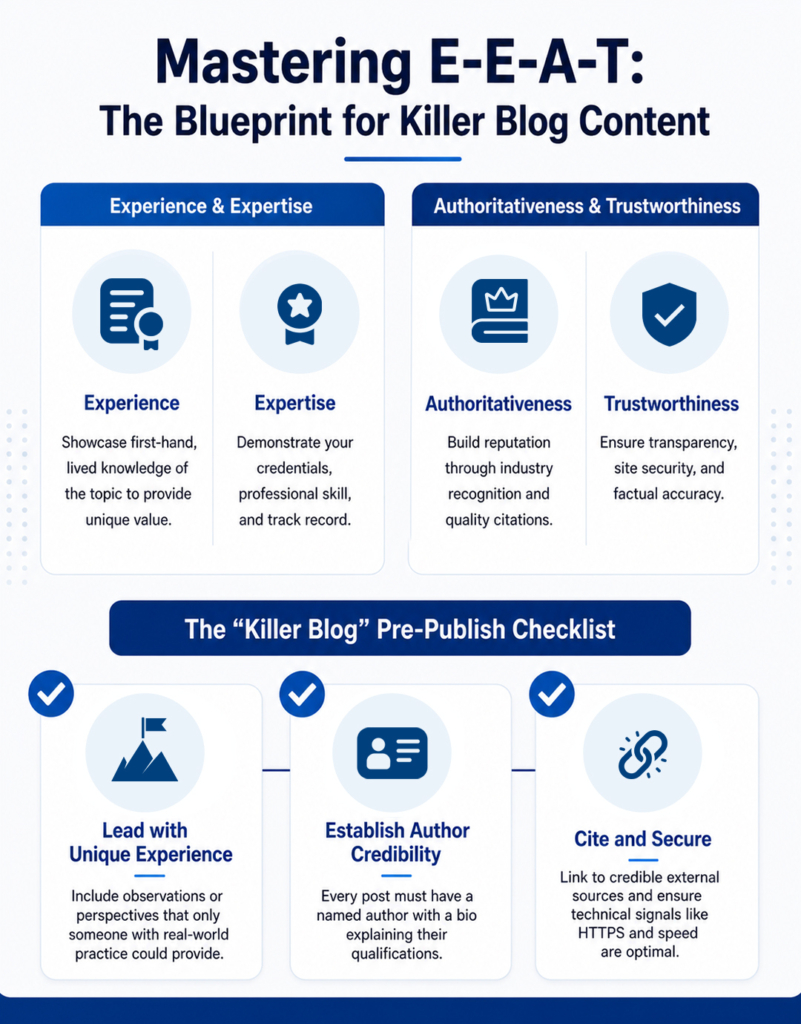
E-E-A-T stands for Experience, Expertise, Authoritativeness, and Trustworthiness. It comes from Google’s Search Quality Rater Guidelines — a document that human quality raters use when evaluating whether search results are actually useful.
Google’s Search Quality Rater Guidelines are publicly available and worth reading if you want to understand how Google thinks about content quality at a fundamental level.
One thing that trips people up: E-E-A-T is not a direct ranking factor in the same way page speed or backlink count are. It’s a framework that shapes how Google’s systems are trained to evaluate content quality. That distinction is actually important, because it means there’s no quick technical fix you can apply to get it right. You have to demonstrate it. There’s no shortcut to that.
What each letter means
Experience is about first-hand, lived knowledge. Has the person writing this actually done the thing they’re writing about? Someone reviewing a product they’ve genuinely used brings something a researcher can’t replicate. A marketing guide written by someone managing real campaigns carries weight that assembled-from-other-articles content doesn’t. This is the newest addition to the framework and, in our view, one of the most important.
Expertise is demonstrable knowledge and skill. It’s what most people jump to when they hear E-E-A-T, and it does matter — but formal credentials aren’t the only route in. Sustained practical experience and a track record that other people can actually verify count too.
Authoritativeness is about reputation and recognition within a field. Do credible sources reference you, cite you, link to you? Are you known in your industry? This one is partly built through content, but it’s also built through everything else — your work, your external presence, your contributions to industry conversations over time.
Trustworthiness is the broadest of the four, and according to Google’s own guidelines, arguably the most important. It covers accuracy, transparency, honest claims, and whether your site gives people a reason to trust what they’re reading. Clear authorship, secure site infrastructure, accurate information, a decent user experience — all of it feeds into this.
Why E-E-A-T matters more now than it did two years ago
Google has always cared about quality. Two things have pushed E-E-A-T much further up the priority list recently.
The first is AI-generated content. Large language models made it genuinely easy for anyone to produce high volumes of plausible-sounding content — content that covers the right topics, uses the right terminology, and broadly says the right things, without any of it coming from real knowledge or experience. Google has had to get considerably better at distinguishing between content that sounds credible and content that actually is. E-E-A-T is central to how it does that.
The second shift is the move toward AI-powered search, including AI Overviews. When Google’s systems pull from multiple sources to construct a synthesised answer in the search results, the content they draw from tends to be content that demonstrates strong E-E-A-T signals. Ranking in a list of links and being cited in an AI-generated answer are increasingly different outcomes — and the latter depends heavily on this framework.
Google’s own guidance on helpful content reinforces this directly, making clear that content should be written for people first, and that demonstrating real expertise is central to what helpful content looks like.
We’ve seen this play out clearly with clients over the past year or so. The gap between content that genuinely demonstrates expertise and content that merely covers a topic has widened in the search results. The former holds its positions and gets cited. The latter gets filtered out.
E-E-A-T and YMYL content
Google applies E-E-A-T standards more stringently in certain areas than others. YMYL — Your Money or Your Life — refers to content that could meaningfully affect a reader’s health, financial decisions, safety, or wellbeing.
Medical advice, financial guidance, legal information, news coverage — these are all YMYL categories. In these areas, the bar is high because the consequences of getting it wrong aren’t just a bad user experience. They can cause real harm. If your business operates in any of these spaces, E-E-A-T isn’t a nice-to-have. It’s the minimum.
For most marketing, retail, or service businesses, the standards are less acute — but the principles hold. Content that makes strong claims, gives advice, or positions itself as authoritative needs to back that up. Industry doesn’t change the underlying expectation.
The most common E-E-A-T mistakes in blog writing
Before getting into what works, it’s worth being honest about what most content gets wrong. These are the patterns we see most frequently.
Writing from research rather than experience. A significant proportion of blog content is, essentially, a better-organised version of other blog content. It hits the right topics, covers the expected ground, says broadly the right things — but there’s nothing in it that only someone with actual experience could have contributed. Google is getting more capable at detecting this, and readers often pick up on it too, even if they couldn’t articulate why.
When we audit content for new clients, this is one of the most common findings. The articles are there. They cover the subject. But there’s nothing that couldn’t have been written by someone who’d never spent a day working in the field. That’s usually the gap holding their rankings back.
No clear authorship. A blog post with no named author, no bio, and no indication of who wrote it or why their opinion is worth reading is a missed opportunity on every dimension of E-E-A-T. It’s also an increasingly visible trust problem. People want to know who they’re reading. Anonymity doesn’t build credibility.
Vague claims without grounding. “Studies show,” “experts agree,” “research suggests” — all of these, without an actual reference, actively erode trust rather than building it. Bold assertions without any real backing are one of the most reliable ways to undermine the trustworthiness dimension.
Optimising for keywords instead of questions. Content built around keyword placement rather than genuinely answering what a reader needs tends to score poorly across all four dimensions. It signals that the content was written to rank rather than to help. Google has become considerably better at telling the difference.
Ignoring technical trust signals. E-E-A-T isn’t just about the writing. A slow site, broken links, no HTTPS, a poor mobile experience — these all chip away at trustworthiness in ways that even well-written content can’t fully compensate for.
Lead with what only you know
The single most impactful thing you can do for E-E-A-T is include something that only someone with real experience could have written. This doesn’t require dramatic revelations or proprietary data. It can be as simple as what you’ve actually seen in practice, where common advice breaks down in the real world, or what your clients have experienced that contradicts the received wisdom.
Writing about Google Ads? Reference something specific from a real campaign — a pattern you’ve seen, an anomaly you’ve had to explain. Writing about SEO? Draw on actual observations from client work rather than restating what everyone else has already said. That specificity is more useful to readers and it’s a genuine signal to Google that the content comes from real knowledge.
Name your authors and build their credibility
Every blog post needs a named author with a bio that makes clear why they’re qualified to write on this particular topic. You don’t need formal credentials for this. You need honesty and specificity about what the person actually knows and how they know it.
Beyond individual posts, consider building proper author pages for everyone who writes for your site — their role, their background, their other published work, links to their professional profiles. A well-built author page creates a credible picture that a single post-level bio can’t achieve on its own.
Be specific, cite your sources, and make accurate claims
Trustworthiness is built through accuracy — and accuracy, in content terms, means citing sources when you reference data or research, not making claims you can’t substantiate, and acknowledging nuance rather than presenting everything as settled fact.
Outbound links to credible sources aren’t just good editorial practice. They tell Google that your content exists within a credible information ecosystem. A piece of writing that references nothing and links nowhere is harder to verify and easier to discount.
Structure your content for clarity and extraction
Clear headings, direct answers, concise definitions — this isn’t just about readability, though that matters too. Well-structured content is significantly more likely to be surfaced by AI-powered search systems that are looking for content they can confidently extract and cite.
Think about what the person arriving at your blog actually needs to know. Answer those questions directly and early. Don’t make someone read three paragraphs of preamble before they find out what you’re actually going to tell them.
Building authoritativeness beyond the blog
This is the section most content guides skip over, which is a shame because it’s where a lot of the real work happens. Authoritativeness isn’t built purely through what you publish on your own site. It’s built through your reputation in the wider information ecosystem — and that requires deliberate effort.
Earn backlinks from credible sources. When respected websites link to your content, it signals to Google that your site is a reference point worth trusting within your field. This doesn’t happen automatically. It happens through producing content that’s genuinely worth linking to, building real relationships within your industry, and sometimes through active outreach.
Seek external mentions and coverage. Being referenced in industry publications, quoted in articles, featured in round-ups, or interviewed on podcasts — all of this contributes to how authoritative your brand looks. These signals exist outside your own website, which is exactly why they carry weight that self-published content alone can’t generate.
Show up in your industry’s conversations. Authoritativeness is partly a function of consistent visibility in the places where your subject matter is actually being discussed. Guest posting, contributing to industry forums, speaking at events, maintaining a credible presence on professional networks — all of it compounds over time.
The clients we work with on long-term SEO who build authority fastest are almost always those investing in both on-page quality and external presence at the same time. One without the other is slow. Together, they reinforce each other in ways that are genuinely difficult to replicate through one channel alone.
The relationship between off-page authority signals and E-E-A-T is well documented in SEO research, with consistent evidence that external recognition contributes meaningfully to how Google evaluates a site’s overall trustworthiness.
Technical trust signals that support E-E-A-T
Good writing is necessary. It’s not sufficient on its own. The technical health of your site feeds directly into the trustworthiness dimension in ways that matter.
HTTPS. If your site is still on HTTP, that needs fixing. A secure connection has been a basic trust signal — and a Google ranking factor — since 2014. There’s no good reason to still be on HTTP.
Page experience and speed. A slow or clunky site undermines trust regardless of what the content says. Google’s Core Web Vitals give you a useful benchmark: loading speed, interactivity, and visual stability. These aren’t just technical metrics — they affect whether people stay and read.
Clear site structure and navigation. A well-organised site that makes it easy to understand who you are, find information, and get in touch signals trustworthiness. A confusing or poorly maintained one signals the opposite — to both users and search engines.
Accurate and complete about information. A clear about page, transparent ownership, current contact details, honest descriptions of what you do and who does it — these all contribute to how trustworthy your site appears. It’s easy to overlook this kind of thing when you’re focused on content, but it’s part of the picture.
How to audit your existing content for E-E-A-T gaps
If you’ve been publishing content for any length of time, it’s worth looking at what you already have through this lens. Here’s a practical starting point.
Go through your most important pages and ask: does this content include first-hand experience, or is it purely assembled from other sources? Is there a named author? Are claims backed up? Is the structure clear and the information actually useful? Does the page load properly and work on mobile?
Pages that fall short across several of those questions are candidates for updating, not deleting. In most cases, improving existing content that already has some authority attached to it is more efficient than starting fresh — and you’re far less likely to lose what you’ve already built.
Google’s own guidance on updating content makes clear that keeping existing pages accurate, useful, and current is a meaningful quality signal.
A practical E-E-A-T checklist for every blog you publish
Before hitting publish, work through these:
Does this post include something only someone with real experience could have written? Is there a named author with a bio that explains their credibility? Is there a link to a full author page? Are all claims accurate, and are sources cited where relevant? Is the structure clear, with direct answers to the questions the reader actually has? Does the post link out to credible external sources where appropriate? Does it link internally to relevant service or supporting pages? Are there any technical issues — slow load times, broken links, mobile problems — that could undermine trust? Would a reader trust this content more after reading it than before?
Yes across all of those, and you’re publishing content that takes E-E-A-T seriously in practice, not just in theory.
The bigger picture
E-E-A-T isn’t a compliance exercise. It’s Google’s attempt to reward content that’s genuinely useful, honestly presented, and produced by people who actually know what they’re talking about. The businesses that treat it that way — as a standard to meet rather than a checklist to tick — are the ones producing content that holds its rankings, earns real authority, and builds the kind of trust with readers that translates into something beyond search traffic.
The other thing worth saying: the path to strong E-E-A-T and the path to simply writing well are largely the same path. Be specific. Be honest. Be useful. Say things that only you, with your actual experience, could say.
That’s what killer content actually looks like.
Conclusion
Knowing what E-E-A-T means is one thing. Building it into every piece of content you produce is genuinely harder — it requires a commitment to quality over volume, real expertise over surface-level coverage, and a long view of what good content is supposed to do both on the page and across your wider digital presence.
If you want help building a content strategy that takes this seriously, or if you’re not sure your current approach is working as hard as it should, we’re always happy to take a look.
Navigating the ever-evolving world of ecommerce can feel like a daunting endeavor. With countless trends, strategies, and technologies emerging daily, how do you separate the wheat from the chaff? For many entrepreneurs, relying solely on guesswork can lead to costly mistakes and missed opportunities. Instead, gaining insights from ecommerce experts can be a game changer—providing clarity and direction.
The Complexity of Ecommerce
The ecommerce landscape is not just about setting up a website and waiting for sales to roll in. It encompasses a multitude of functions, including marketing, customer service, supply chain management, and data analytics. Each of these areas has its intricacies, and understanding them requires experience and expertise.
When entrepreneurs start from scratch—or even when they have some experience—they often stick to what they know or glean from informal sources. While intuition and trial-and-error can sometimes yield results, they often come with steep learning curves and inconsistent outcomes. In contrast, leveraging expert opinions can provide tried-and-true methods that have been tested against industry challenges.
The Value of Expert Insights
Listening to ecommerce experts offers multiple avenues for gaining knowledge:
Access to Real-World Experience
Experts who have built successful online stores bring invaluable insights based on their experiences. They can share what worked, what didn’t, and why. This type of firsthand knowledge is something you can’t find in textbooks or casual online articles.
For instance, experts often discuss the importance of A/B testing on landing pages, emphasizing how even minor changes in design or copy can lead to significant conversion rate improvements. This is a lesson best learned from those who have faced the same challenges first-hand.
Current Trends and Changes
The ecommerce landscape is continuously changing, influenced by shifting consumer behaviors, emerging technologies, and economic factors. Expert discussions, such as the ones you can find in expert discussions on scaling online stores, can help you stay ahead of the curve. Listening to these discussions can provide insights into trending platforms, customer engagement strategies, and the latest tools that can help improve your online business.
Networking and Community
Engaging with the ecommerce community involves more than just gaining information; it opens up opportunities for networking. When you listen to podcasts or webinars featuring industry leaders, you’re often introduced to their communities. This can lead to collaborations, partnerships, and support from like-minded individuals who share your passion and understand your challenges.
Actionable Steps and Strategies
Along with insights, experts often provide practical steps to implement strategies. Whether it’s optimizing your website’s SEO, effectively utilizing social media advertising, or implementing data analytics for better decision-making, experienced professionals offer clear pathways and tools to enhance your business operations. Discussing these real-world applications demystifies complex concepts, making them accessible for everyone.
Listening vs. Doing
While doing is a crucial part of the learning process, listening to experts can save you time and resources. Think of it this way: would you prefer to navigate a complex terrain with a map or venture out without any guidance?
In your ecommerce journey, it may be tempting to dive directly into implementing strategies based solely on your experiences or assumptions. However, this approach can lead to confusion and setbacks, especially when you hit roadblocks that experienced entrepreneurs have already overcome. Listening to their insights can not only shortcuts your learning curve but also help you avoid potential pitfalls.
Examples from the Field
Consider the case of an entrepreneur who launched a subscription box service. Based on market research, they believed that their product would be best marketed via Instagram. However, when they attended an online seminar where an expert discussed customer acquisition through email marketing, they pivoted their strategy—and saw a 30% increase in conversions within weeks. This kind of success story underscores the importance of being open to expert advice.
Implementing What You Learn
Once you’ve tapped into expert discussions, the next step is to implement the strategies discussed. Here are some actionable ways to put expert insights into practice:
1 Create a Learning Plan: Identify key areas of your business that need improvement and source relevant materials—podcasts, webinars, or articles—addressing those topics.
2 Devote Time Weekly: Set aside a specific time each week to engage with expert content. This can be educational podcasts or reading interviews with successful entrepreneurs.
3 Take Notes and Reflect: As you listen or read, jot down key takeaways and reflect on how you might apply them to your current strategies.
4 Engage with the Community: Join forums, social media groups, or even attend events where you can connect with the ecommerce community, share your experiences, and learn from others.
5 Test and Evaluate: Implement what you learn in small tests first to gauge effectiveness before rolling out large-scale changes. Utilize metrics and KPIs to evaluate outcomes.
Conclusion
In the vast and complex world of ecommerce, guesswork can lead to uncertainty and frustration. On the other hand, listening to and learning from ecommerce experts can provide a wealth of knowledge that not only guides your decisions but also enhances your overall business strategy.
As you navigate your ecommerce journey, remember that expertise is a valuable resource. Don’t shy away from leveraging the wisdom of those who have walked the path before you—the insights gained from expert discussions can set the trajectory for your success.
Picking a website platform used to be straightforward. A few years ago, most marketing teams were debating WordPress versus Squarespace and not much else. That conversation looks completely different now.
Today you have AI builders like Lovable that claim you can go from a text prompt to a live site before lunch. You have Framer, which has quietly become a serious tool for design teams who want pixel-level control without touching code. Webflow has built a dedicated following among developers and marketers who want something between the rigidity of WordPress and the chaos of fully custom builds. And Wix and Squarespace — long dismissed as “beginner tools” — have genuinely improved to the point where that label no longer fits.
So where does that leave you when you’re trying to make a decision for your actual business?
Honestly, the answer depends on things that matter: what your site needs to do in practice, how much ownership you want over it long-term, who on your team is going to manage it, and where you want to be in two or three years. This isn’t one of those guides that hedges every answer to the point of uselessness. We’re going to work through each platform properly, explain where the newer AI tools genuinely deliver, and make the case for why WordPress is still the right default for most businesses with serious digital ambitions — even if it isn’t the most exciting answer.
First, what is vibe coding and why is everyone talking about it?
If you’ve spent any time in marketing or tech circles in the past year, you’ve probably seen the term “vibe coding” thrown around. It describes the practice of building websites or software using AI — usually by describing what you want in plain language and letting the AI generate the underlying code. Lovable is probably the most prominent example of this approach done at scale.
And the honest reaction when you first see it? It’s impressive. Someone with zero coding background can sit down, type a description of what they want, and have something that looks like a working website within a few hours. For developers, AI-assisted coding has become a genuine productivity tool rather than a novelty.
The problem is that “looks like a website” and “functions reliably as one over time” are two different things. That gap — between the impressive demo and the reality of running a production site at scale — is where most serious conversations about these tools eventually land.
WordPress: why it is still the default for most businesses
WordPress runs roughly 40 percent of every website on the internet. That number gets quoted so often it starts to lose meaning, but it’s worth sitting with for a moment. That market share isn’t the result of inertia alone. It reflects something real about what the platform actually delivers.
Ownership and flexibility
WordPress is open source. You own your site — not a version of it that lives inside someone else’s ecosystem, but the actual thing. Your content, your data, your codebase. If your hosting company goes bust, you move. If a plugin stops being supported, you find another one or have someone build what you need. Nothing about the platform’s survival depends on a single company’s funding round or pricing decisions.
This sounds abstract when you’re choosing a platform for the first time. It sounds a lot less abstract when you’ve been working with a client for two years, they’ve built something substantial, and they start bumping against the walls of a proprietary tool they can’t get out of without rebuilding from scratch. We’ve had that conversation more times than we’d like.
The plugin ecosystem
The WordPress plugin library covers almost everything a business website might need — SEO tooling, e-commerce, membership areas, booking systems, CRM integrations, multilingual support, forms, analytics, the list goes on. Most of it is documented well, supported actively, and proven in production environments.
This is one of the areas where AI builders like Lovable genuinely cannot compete right now. A site generated by an AI tool might look sharp in the browser, but the moment you need real functionality — a booking system that syncs with your CRM, a membership platform with tiered access, a product catalogue with complex filtering — you’re very quickly at the edge of what those tools can handle.
SEO capability
WordPress with Yoast or Rank Math gives you control over every technical SEO element that matters: meta titles, descriptions, canonical tags, schema markup, XML sitemaps, redirects. When you combine that with a properly built theme and clean hosting, it’s the strongest SEO foundation available without hiring a developer to build something custom.
None of this means WordPress is without problems. It needs maintenance. Security requires attention, particularly around plugin updates and hosting configuration. Performance isn’t automatic — you need decent hosting, proper caching, and image optimisation as a baseline. And while Gutenberg has improved the editing experience considerably, it still has a learning curve compared to newer tools.
For a business with no technical resource whatsoever, getting WordPress set up properly can feel like more than they signed up for. That’s a fair concern.
What we’ve seen in practice: the businesses that get genuine value from WordPress are the ones that invest in a properly built theme, reliable hosting, and at least some ongoing developer support. The ones who struggle are usually those who installed it because it was free, assumed that meant it was easy, and then found themselves maintaining something they didn’t fully understand. That’s not a WordPress problem, but it is a WordPress reality.
Lovable: genuinely impressive, but know what you are getting
Lovable has had a lot of attention recently, and it’s earned some of it. The demos are good. The speed at which you can get from a rough idea to something that resembles a working site is genuinely new — and for certain use cases, that speed advantage is real.
Where Lovable works well
If you need a prototype fast, a landing page for a specific campaign, or a proof-of-concept to test with users before committing to a full build, Lovable is a legitimate tool to consider. The turnaround time is hard to argue with.
It’s also worth being clear-eyed about the trajectory. AI-assisted development is improving quickly. What these tools can’t do reliably today is a moving target.
Where Lovable falls short for serious business websites
The structural problem with AI-generated websites — and this applies to Lovable and tools like it — is that the code produced is functional-looking rather than architecturally sound. It can look great in a browser while being genuinely difficult to extend, debug, or optimise under the surface.
SEO capability is limited. Third-party integrations are restricted. Performance optimisation requires a kind of structural decision-making that AI generation doesn’t reliably produce. And because the code wasn’t planned — it was generated — adding new features often means rebuilding sections rather than developing them incrementally.
There’s also the ownership question. Sites built in Lovable exist within Lovable’s ecosystem. If the platform changes its pricing model, alters its terms, or pivots its product roadmap, your options narrow quickly.
The short version: Lovable is a useful tool for specific jobs. It isn’t a replacement for a properly built business website, and it’s worth being clear-headed about that distinction before committing.
Framer: the designer’s platform
Framer has found a clear lane for itself — design-led websites where visual quality and interaction polish matter above almost everything else. For creative teams, agencies, and brands where the website is itself a statement of aesthetic standards, it’s hard to argue with what Framer can produce.
Where Framer works well
Portfolio sites, agency sites, product launch pages, design-forward brands — Framer excels in these contexts. The visual control is genuinely impressive, the hosting is fast, and the workflow for design teams is cleaner than most alternatives. If looking exceptional in the browser is the primary brief, Framer is one of the strongest options available.
Where Framer has limitations
Complex functionality isn’t Framer’s strength. Large content sites, businesses with serious SEO requirements, or teams that need significant third-party integrations tend to run into its ceiling fairly quickly. The CMS works, but it’s limited relative to WordPress. The integration ecosystem is narrower.
And like most design-led platforms, Framer is proprietary and hosted. You’re renting the platform rather than owning it. If you outgrow Framer, migration is a significant project — not an afternoon task.
Webflow: the powerful middle ground
Webflow sits in an interesting spot. It offers more design flexibility than WordPress out of the box, more structural integrity than AI builders, and more functionality than Framer. For teams who have the capacity to learn it properly, it’s a genuinely strong platform.
Where Webflow works well
Marketing sites, landing pages, and content-driven sites where both visual quality and performance matter are Webflow’s sweet spot. The visual builder gives designers real control, the hosting is fast, and the CMS handles most business content needs comfortably.
The integration ecosystem has grown considerably, and the community around the platform is active and well-resourced — which addresses some of the flexibility limitations that used to hold it back.
Where Webflow has limitations
The learning curve is steeper than most platforms. It’s expensive relative to WordPress once you’re operating at any meaningful scale. E-commerce functionality has improved, but for complex retail requirements, WooCommerce still has a significant advantage. And as a proprietary platform, you carry the same dependency risk as Framer — what you’ve built lives within Webflow’s ecosystem.
Comparisons between Webflow and WordPress for business use cases tend to highlight the trade-off between design flexibility and long-term extensibility as the central decision point.
Wix and Squarespace: better than their reputation, but know the ceiling
Both platforms have improved considerably over the past few years, and they deserve more credit than they tend to get in professional marketing discussions.
For small businesses, sole traders, and anyone who needs a presentable online presence without technical complexity, Wix and Squarespace genuinely deliver. They’re easy to use, they look decent without much effort, and basic SEO needs are handled adequately.
Where it gets complicated is growth. SEO capability hits limits faster than WordPress. Customisation runs into walls that can’t be worked around. And migrating away from either platform once you’ve built something significant is genuinely painful — your content is tied to their infrastructure in ways that make leaving expensive.
In practice, Wix and Squarespace tend to work best as a starting point for businesses that aren’t yet ready to invest in a properly built site — with the understanding that there’s likely a migration ahead as things develop. For businesses that have serious digital marketing goals from day one, they’re rarely the right long-term foundation.
How to choose the right platform for your business
Rather than a neat ranking, here’s a practical decision framework — based on what we’ve actually seen work across different business types, budgets, and growth stages.
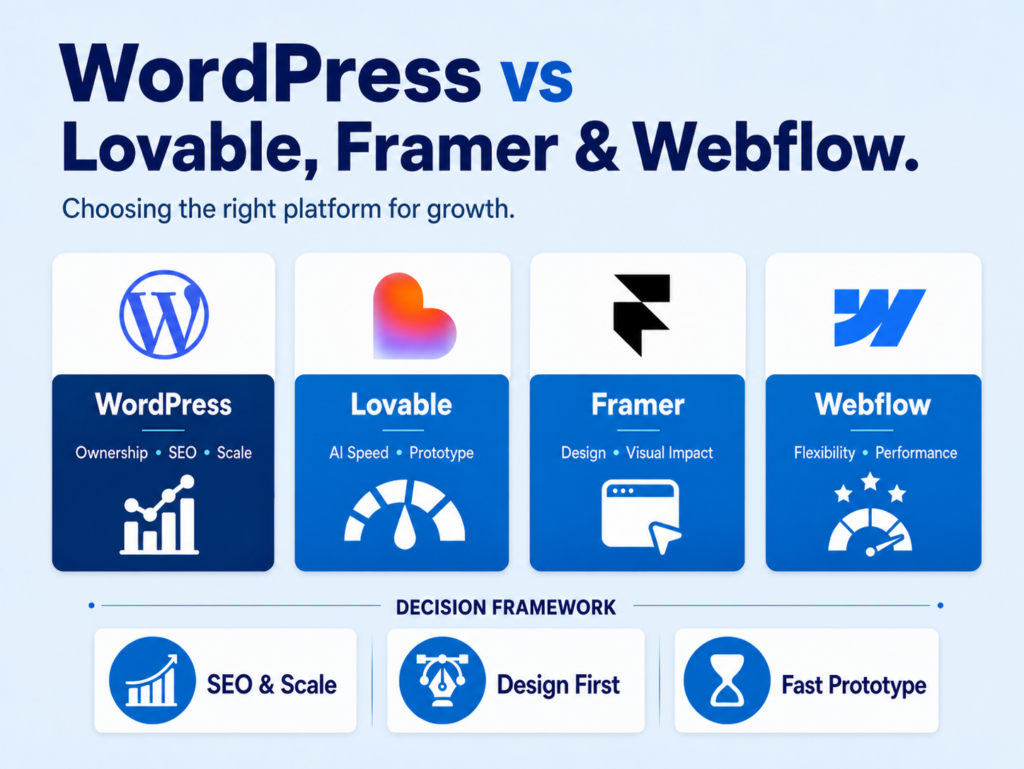
Choose WordPress if you want complete ownership, you have real SEO ambitions, you need complex functionality or third-party integrations, you’re planning to scale, or you want access to the widest possible pool of developer talent when you need support.
Choose Lovable or a similar AI builder if you need a prototype or proof of concept quickly, you’re building a simple landing page for a campaign, or you want to test an idea before committing to a full build. Don’t use it as the foundation for a production site you intend to grow.
Choose Framer if visual design is your primary concern, you’re running a creative agency or design-forward brand, and your functional requirements are relatively straightforward.
Choose Webflow if you want more design flexibility than WordPress provides out of the box, your team has the time and capacity to learn the platform properly, and you don’t have complex e-commerce or plugin-dependent functionality in your roadmap.
Choose Wix or Squarespace if you’re early stage, your budget is limited, you need something live quickly, and you understand that migration is likely in your future as the business grows.
The bigger picture on AI builders and vibe coding
Dismissing AI website builders as a gimmick would be a mistake. The speed of development in this space is real, and the use cases where these tools genuinely add value are expanding.
But there’s a pattern we come across repeatedly when clients arrive having built their site on an AI platform or a beginner-friendly builder. The site looks fine — sometimes it looks great. But underneath, it can’t do what the business actually needs, it resists proper SEO optimisation, and extending it tends to mean rebuilding rather than building on. The short-term speed gain becomes a longer-term cost.
A business website isn’t a brochure. For most companies, it’s the hub of the entire digital marketing operation — the destination for paid traffic, the thing that converts organic visitors, the place where a first impression becomes either trust or a bounce. Building that on a platform with structural limitations is a risk that tends to surface at exactly the wrong moment — usually when the business is growing and needs the site to perform most.
Conclusion
The right platform is the one that fits what your business genuinely needs — not just today, but over the next two or three years. For most businesses with serious digital marketing goals, that’s WordPress. For specific use cases, AI builders and design-focused platforms have real merit and are worth considering honestly rather than dismissing.
The mistake we see most often is choosing based on what looks most impressive in a demo, or what gets a site live quickest, rather than what will actually serve the business as it grows.
If you’re unsure which platform fits your situation, or if you’ve inherited a site built on the wrong foundation and you’re starting to feel the limits of it, we’re always happy to have that conversation.
Most website owners focus on publishing new content. They track rankings for fresh articles and celebrate new traffic gains. But the old posts sitting quietly in the archive can quietly pull the entire site down. Old blog content can confuse search engines, split traffic across multiple pages, and send signals that lower overall site quality. Understanding how this happens is the first step to fixing it.
How Old Posts Stop Matching Search Intent
Search intent changes over time. A post that perfectly answered a question in 2018 may now answer a completely different question than what users are actually searching for today.
Google updates its understanding of queries constantly. When users search for “best project management tools,” they expect a current list with up-to-date pricing and features. A blog post from 2016 with outdated software, discontinued products, and old pricing structures no longer serves that intent. Google recognizes this mismatch. The result is a drop in rankings, even if the post once ranked well.
A real example: HubSpot’s content audit findings
HubSpot conducted a large-scale content audit and discovered that a significant portion of its old blog posts were generating almost no traffic. Many of those posts were optimized for keywords that users no longer searched the same way. The team found that refreshing underperforming content led to traffic increases of 106% on some updated posts. The lesson was clear: old posts left unchanged become liabilities.
How Google evaluates freshness
Google uses a freshness algorithm, known in SEO circles as QDF (Query Deserves Freshness). For certain topics, Google actively boosts newer content. Categories like news, product recommendations, how-to guides for software, and health advice all fall into this freshness-sensitive group. An old post targeting these topics competes at a significant disadvantage.
Beyond freshness, Google also evaluates accuracy signals. A post that links to dead URLs, references products that no longer exist, or contains statistics from ten years ago sends low-quality signals. These signals reduce the post’s authority and can reduce the site’s overall trust score.
Intent shifts in practice
Consider the keyword “iPhone camera tips.” A post from 2015 targets the iPhone 6. Users in 2025 have iPhone 16 Pro models. The content no longer matches what they need. Users land on the page, see outdated information, and leave immediately. The bounce rate climbs. Dwell time drops. Google interprets these behavioral signals as proof that the page is not useful. The ranking drops further, and the cycle continues.
The same pattern applies to financial content, legal information, and medical articles. A blog post about tax brackets from five years ago is not only less useful but can actively mislead readers, which creates trust problems for the site.
How Old Posts Can Take Traffic from Better Pages
One of the less obvious ways old posts damage SEO is through keyword cannibalization. This happens when two or more pages on the same site target the same keyword or topic. Search engines struggle to decide which page to rank. Both pages end up ranking lower than either would if it were the only page targeting that keyword.
What cannibalization looks like in practice
Imagine a marketing blog that published a post called “Email Marketing Tips” in 2017 and then published a more detailed, updated version called “Email Marketing Tips for 2024” in 2024. Both posts target similar search phrases. Google indexes both. Instead of the stronger 2024 post ranking in position 2, both posts rank at positions 11 and 14. Neither one reaches the first page.
This is a common situation. Orbit Media Studios found that marketers who regularly blog often accumulate dozens of overlapping posts over time without realizing it.
Traffic splitting reduces conversion potential
Traffic splitting also reduces the effectiveness of link building. When external sites link to your content on a topic, those links may go to the old post rather than the newer, better one. The authority from those backlinks supports the old page, not the page that currently serves users best.
Some site owners try to build or buy website traffic to boost their newer pages. This strategy can support visibility while SEO efforts mature, particularly when a site is working to establish authority for updated content. However, it works best alongside structural fixes like proper canonicalization and internal linking.
A documented case: Backlinko’s content pruning results
Brian Dean at Backlinko shared a case where he deleted and consolidated a large number of low-quality posts. After reducing his total post count significantly and redirecting old URLs to stronger content, his organic traffic increased. He attributed this to Google now seeing a higher ratio of strong content versus weak content on the site. The site’s overall quality signal improved when the weaker pages were removed from the equation.
Why Google ranks the wrong page
When two pages compete for the same query, Google often ranks the older page because it has more backlinks and a longer history. This means a site can have a well-written, accurate, and useful new post sitting on page three while an outdated old post holds a weak position on page one. The site loses in both cases: the old post converts poorly, and the better post gets no visibility.
The fix requires active management. It means choosing which page should rank, redirecting or merging the other, and pointing internal links to the page you want Google to prioritize.
How to Find Old Posts That Are Hurting SEO Traffic
Finding the posts that are dragging down performance requires a structured process. The good news is that free and low-cost tools make this accessible for any site owner.
Step 1: Run a content inventory
Use Google Search Console to export all URLs that received impressions in the past 12 months. Filter for pages with high impressions but low click-through rates. These pages appear in search results but fail to attract clicks. This often signals that the title and meta description are outdated or that the content no longer matches what users want.
Next, look for pages with declining traffic trends. Google Search Console allows you to compare time periods. Pages that received steady traffic 18 months ago but now receive very little are candidates for review.
Step 2: Check for keyword cannibalization
Use a tool like Ahrefs, Semrush, or even a simple Google search to find overlap. Search “site:yourdomain.com keyword” to see how many pages your site has on the same topic. If you find three or four posts covering similar ground, cannibalization is likely happening.
Semrush has a dedicated cannibalization report in its Position Tracking tool. It highlights keywords where multiple pages are competing against each other. This report can surface dozens of issues on a blog with several years of content.
Step 3: Evaluate each post with a content quality checklist
For each post flagged in your audit, check the following:
Does the post still accurately cover the topic as it exists today?
Does the post contain broken links, outdated statistics, or discontinued references?
Does the post still match the search intent behind its target keyword?
Is there a newer, stronger post covering the same topic?
Has the post received any backlinks worth preserving?
Posts that fail most of these checks are candidates for updating, consolidating, or removing.
Step 4: Decide on an action for each post
There are four main actions to take with underperforming old posts.
The first is to update the post. Refresh statistics, update examples, fix broken links, and rewrite sections that no longer reflect current knowledge. This works well when the post has some backlinks and targets a relevant keyword.
The second is to consolidate. Merge two or more similar posts into one comprehensive piece. Redirect the old URLs to the new consolidated page. This concentrates authority and removes cannibalization.
The third is to redirect and delete. If a post has no backlinks, low word count, and targets an outdated topic, redirecting it to a relevant page and removing the content can improve the site’s overall quality ratio.
The fourth is to add canonical tags. If two versions of similar content need to exist for legitimate reasons, a canonical tag tells Google which version to prioritize in rankings.
Real-world example: Zapier’s content strategy
Zapier regularly audits its content library, which contains thousands of posts. The company identifies posts that rank below position 20 for their target keywords and either updates or removes them. This process is part of its standard content operations. Zapier has credited ongoing content maintenance as a key factor in sustaining its organic growth despite heavy competition in the productivity software space.
How often should you audit old posts?
For most blogs, a full audit once per year is practical. Sites that publish frequently, such as news sites or marketing blogs with hundreds of posts, benefit from quarterly reviews of their lowest-performing content.
Setting up automated alerts in Google Search Console for pages with sudden traffic drops can also help catch problems early before they compound.Old blog posts do not maintain their value automatically. Without active maintenance, they gradually stop matching what users need, compete against your own stronger pages, and send low-quality signals to search engines. A regular audit process identifies which posts to update, merge, or remove. Sites that treat content as a living library rather than a static archive consistently maintain stronger organic traffic over time.
There’s a shift happening in digital marketing that goes well beyond the AI content debate — and it’s moving faster than most marketing teams have caught up with.
Agentic AI refers to systems that don’t just respond to prompts. They plan, make decisions, use tools, and complete multi-step tasks without needing a human steering every move. That distinction might sound technical, but its implications for how people search, how Google surfaces content, and how paid advertising is bought and managed are already measurable. This isn’t something that’s coming. Parts of it are already here, already affecting performance, and already rewarding some strategies while quietly making others redundant.
What is agentic AI, and why does it matter for marketers?
Most of the AI conversation in marketing over the past two years has centred on generative tools — things that produce content, copy, or images when you give them a prompt. Agentic AI is a genuinely different category.
An AI agent receives a goal and works through it: breaking the objective into tasks, using tools to gather information, making decisions along the way, and completing the job without a human directing each step. The gap between these two things is significant. There’s a real difference between asking someone to write a product description and asking them to research competitor pricing, identify gaps in your product page, rewrite the copy, and test it — all without you needing to be involved at each stage.
Google’s own research and developer documentation has outlined how agents interact with the web in fundamentally different ways to traditional users.
Agents are now being used by consumers, by search engines themselves, and by the advertising platforms you’re already spending money on. That’s why this matters to marketing teams. The rules around visibility and campaign performance are being rewritten around them, and the adjustment period is shorter than most people expect.
How agentic AI is changing SEO
Search is becoming a task, not just a query
The traditional search model is straightforward enough. A user types a query, a list of results comes back, someone clicks through. SEO was built almost entirely around optimising for that moment — the click.
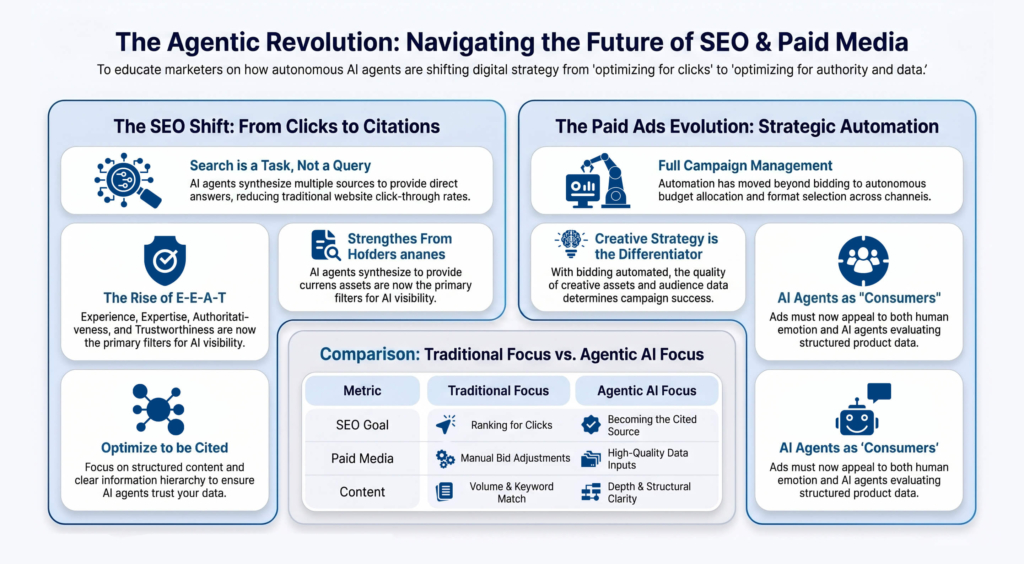
Agentic AI disrupts this at a structural level. When someone uses an AI agent to research something — whether that’s Google’s AI Overviews, a standalone AI assistant, or an agentic tool browsing on their behalf — the agent is synthesising information from multiple sources and presenting an answer directly. Your page may never get visited at all. The user got what they needed without the click ever happening.
That doesn’t mean SEO is finished. It means the objective has changed. You’re no longer optimising purely to rank for a click. You’re optimising to be the source that the agent chooses to trust and cite.
Google’s AI Overviews have already shown how this works in practice, pulling structured, authoritative content and surfacing it without requiring a traditional click.
E-E-A-T becomes even more important
Experience, expertise, authoritativeness, and trustworthiness have been central to Google’s quality framework for years. In an agentic AI environment, they carry even more weight than before.
AI agents — including Google’s own systems — are built to favour content that demonstrates real knowledge over content that matches keywords. Which means the old playbook of producing high volumes of surface-level content optimised around exact-match phrases isn’t just less effective than it used to be. It actively works against you now. The signal you send is that your content exists to rank, not to help anyone with anything.
The businesses that hold their positions in AI-influenced search are those producing content that answers questions with actual depth, reflects genuine expertise, and is structured in a way that both humans and AI systems can read, understand, and extract from easily.
Structured content and clarity will determine AI visibility
One concrete implication of agentic AI in search: well-structured content gets cited more often. Clear headings, direct answers, concise definitions, logical hierarchy — these make it easier for an AI system to pull from your content with confidence. It’s not dramatically different from what good SEO has always looked like, but the emphasis has sharpened considerably.
A post that wanders, buries its key points three paragraphs in, or answers questions indirectly is less likely to be surfaced by an AI agent — regardless of how well it sits in traditional organic rankings. Clarity isn’t just reader-friendly anymore. It’s a competitive advantage in how AI systems make citation decisions.
How agentic AI is changing paid advertising
Automation has moved from bidding to full campaign management
Paid media has been moving toward AI-driven automation for a while. Agentic AI accelerates that trend significantly. Google’s Performance Max campaigns are probably the clearest current example: rather than building individual ad groups with tightly managed keywords, advertisers provide creative assets, audience signals, and a conversion goal, then the system allocates budget, selects formats, and adjusts bidding autonomously across channels.
What this demands from marketers has shifted accordingly. Understanding match types and bid adjustments matters less than it did. What matters now is knowing how to give AI systems the right inputs — quality creative, clean and meaningful conversion data, well-defined audience signals. The lever has moved upstream.
AI agents as consumers are changing how ads need to work
There’s a longer-term dynamic worth watching carefully. As AI agents become capable of completing purchasing tasks on behalf of users — researching products, comparing options, even making transactions — the question of what paid advertising is actually for starts to shift.
Ads built purely around human emotional appeal may become less effective when the entity doing the evaluating is an AI agent working through structured data, not a person browsing on their lunch break. That’s not a distant hypothetical. It’s already a consideration for businesses in categories where comparison and research are significant parts of the buying process.
Research into AI’s impact on consumer decision-making has highlighted how agentic tools are beginning to reshape the purchase journey in measurable ways.
The gap between creative strategy and automation is growing
One of the less-discussed consequences of agentic AI in paid media is that it makes the creative and strategic layer more important, not less. If the platform is handling bidding and placement automatically, what separates good performance from wasted budget is the quality of what you feed it.
Strong creative, accurate audience data, and clean conversion tracking are no longer things you get to when you have spare time. They’re what determine whether automated systems perform or burn through budget without producing much. The machine only works as well as the brief you give it.
What this means for your marketing strategy
Integration matters more than ever
One of the clearest things the agentic AI shift makes visible: siloed marketing stops working. SEO, paid media, content, and web experience need to function as a joined-up system, because AI systems — both in search and in advertising platforms — evaluate the full picture, not just one piece of it.
A paid ad sending traffic to a poor landing page will underperform in automated bidding systems that factor in post-click behaviour. A blog post that gets cited in AI Overviews but leads to a confusing website loses the conversion opportunity even when it wins the visibility battle. These things compound in both directions.
We’re already seeing this with clients. Businesses with well-structured, genuinely useful content are holding their positions in AI-influenced search far better than those running older volume-led SEO approaches. On the paid side, the campaigns performing best are those where creative and data foundations are solid — the bidding setup is almost secondary.
Google’s helpful content guidance reinforces this, emphasising that content should serve users holistically rather than trying to game individual ranking signals.
Be the source, not just the page
The practical shift for most businesses comes down to this: stop optimising purely for clicks and start optimising to be cited. That means content with genuine depth, clear structure, and real authority behind it. It means thinking about how your content reads to an AI agent, not just where it sits in a list of ten blue links.
It also means taking E-E-A-T seriously at an operational level — attributing content to credible authors, building external recognition, ensuring your site signals trustworthiness across every dimension, not just the writing.
The opportunity in the shift
Worth being direct about this: the businesses that take this seriously now will be better positioned as these changes continue to accelerate. Agentic AI’s influence on search behaviour and paid media performance is already showing up in the numbers. It’s not something to plan for next year.
The good news is that the fundamentals haven’t changed as much as the mechanics have. Quality content, strong creative, coherent strategy, genuine expertise — these have always been the foundations of marketing that actually works. What agentic AI is doing is raising the stakes for getting those fundamentals right, and widening the gap between businesses that do and those that don’t.
Conclusion
Agentic AI isn’t arriving — it’s already reorganising how visibility and performance work across organic search and paid advertising. The businesses adapting most successfully are those treating SEO and paid media not as separate channels or isolated tactics, but as part of a coherent, quality-led digital presence.
If you want to understand what these changes mean for your specific situation — and what a more integrated strategy looks like in practice — the Nautilus team is always happy to have that conversation.
 info@nautilusmarketing.co.uk
  020 4513 9344