info@nautilusmarketing.co.uk
  020 4513 9344





 14 minutes
 May 12, 2026
E-E-A-T gets mentioned constantly in SEO conversations. It also gets misunderstood constantly, which is a slightly different problem.
Most content that tries to explain it ends up doing a surface-level run through the acronym and calling it a day. You leave knowing what the letters stand for, but not much clearer on what to actually do about it. That’s the gap this guide is trying to close.
We’re going to cover what E-E-A-T genuinely means, why it matters more now than it did even two years ago, what most content gets wrong about it, and how to build it into your writing in ways that make a real difference. There’s also a practical checklist at the end for every post you publish.
One thing worth saying upfront: a guide about E-E-A-T should itself be a decent example of E-E-A-T in action. We’ve written this one with that in mind.
What is E-E-A-T?
E-E-A-T stands for Experience, Expertise, Authoritativeness, and Trustworthiness. It comes from Google’s Search Quality Rater Guidelines — a document that human quality raters use when evaluating whether search results are actually useful.
Google’s Search Quality Rater Guidelines are publicly available and worth reading if you want to understand how Google thinks about content quality at a fundamental level.
One thing that trips people up: E-E-A-T is not a direct ranking factor in the same way page speed or backlink count are. It’s a framework that shapes how Google’s systems are trained to evaluate content quality. That distinction is actually important, because it means there’s no quick technical fix you can apply to get it right. You have to demonstrate it. There’s no shortcut to that.
What each letter means
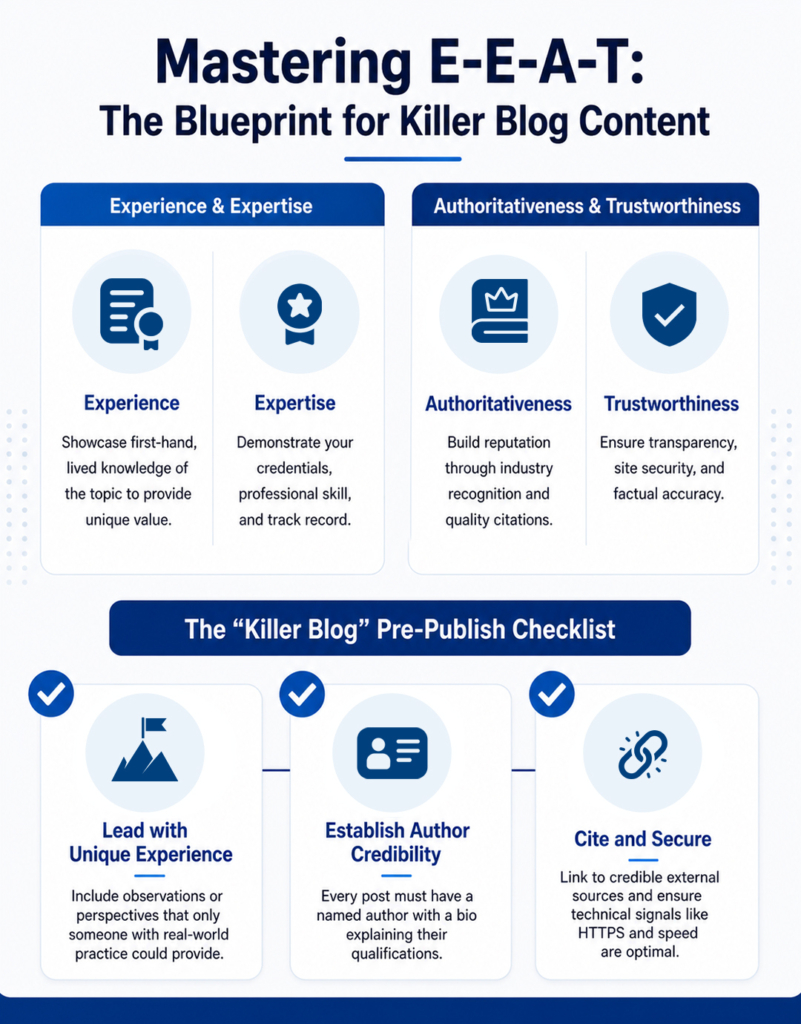
Experience is about first-hand, lived knowledge. Has the person writing this actually done the thing they’re writing about? Someone reviewing a product they’ve genuinely used brings something a researcher can’t replicate. A marketing guide written by someone managing real campaigns carries weight that assembled-from-other-articles content doesn’t. This is the newest addition to the framework and, in our view, one of the most important.
Expertise is demonstrable knowledge and skill. It’s what most people jump to when they hear E-E-A-T, and it does matter — but formal credentials aren’t the only route in. Sustained practical experience and a track record that other people can actually verify count too.
Authoritativeness is about reputation and recognition within a field. Do credible sources reference you, cite you, link to you? Are you known in your industry? This one is partly built through content, but it’s also built through everything else — your work, your external presence, your contributions to industry conversations over time.
Trustworthiness is the broadest of the four, and according to Google’s own guidelines, arguably the most important. It covers accuracy, transparency, honest claims, and whether your site gives people a reason to trust what they’re reading. Clear authorship, secure site infrastructure, accurate information, a decent user experience — all of it feeds into this.
Why E-E-A-T matters more now than it did two years ago
Google has always cared about quality. Two things have pushed E-E-A-T much further up the priority list recently.
The first is AI-generated content. Large language models made it genuinely easy for anyone to produce high volumes of plausible-sounding content — content that covers the right topics, uses the right terminology, and broadly says the right things, without any of it coming from real knowledge or experience. Google has had to get considerably better at distinguishing between content that sounds credible and content that actually is. E-E-A-T is central to how it does that.
The second shift is the move toward AI-powered search, including AI Overviews. When Google’s systems pull from multiple sources to construct a synthesised answer in the search results, the content they draw from tends to be content that demonstrates strong E-E-A-T signals. Ranking in a list of links and being cited in an AI-generated answer are increasingly different outcomes — and the latter depends heavily on this framework.
Google’s own guidance on helpful content reinforces this directly, making clear that content should be written for people first, and that demonstrating real expertise is central to what helpful content looks like.
We’ve seen this play out clearly with clients over the past year or so. The gap between content that genuinely demonstrates expertise and content that merely covers a topic has widened in the search results. The former holds its positions and gets cited. The latter gets filtered out.
E-E-A-T and YMYL content
Google applies E-E-A-T standards more stringently in certain areas than others. YMYL — Your Money or Your Life — refers to content that could meaningfully affect a reader’s health, financial decisions, safety, or wellbeing.
Medical advice, financial guidance, legal information, news coverage — these are all YMYL categories. In these areas, the bar is high because the consequences of getting it wrong aren’t just a bad user experience. They can cause real harm. If your business operates in any of these spaces, E-E-A-T isn’t a nice-to-have. It’s the minimum.
For most marketing, retail, or service businesses, the standards are less acute — but the principles hold. Content that makes strong claims, gives advice, or positions itself as authoritative needs to back that up. Industry doesn’t change the underlying expectation.
The most common E-E-A-T mistakes in blog writing
Before getting into what works, it’s worth being honest about what most content gets wrong. These are the patterns we see most frequently.
Writing from research rather than experience. A significant proportion of blog content is, essentially, a better-organised version of other blog content. It hits the right topics, covers the expected ground, says broadly the right things — but there’s nothing in it that only someone with actual experience could have contributed. Google is getting more capable at detecting this, and readers often pick up on it too, even if they couldn’t articulate why.
When we audit content for new clients, this is one of the most common findings. The articles are there. They cover the subject. But there’s nothing that couldn’t have been written by someone who’d never spent a day working in the field. That’s usually the gap holding their rankings back.
No clear authorship. A blog post with no named author, no bio, and no indication of who wrote it or why their opinion is worth reading is a missed opportunity on every dimension of E-E-A-T. It’s also an increasingly visible trust problem. People want to know who they’re reading. Anonymity doesn’t build credibility.
Vague claims without grounding. “Studies show,” “experts agree,” “research suggests” — all of these, without an actual reference, actively erode trust rather than building it. Bold assertions without any real backing are one of the most reliable ways to undermine the trustworthiness dimension.
Optimising for keywords instead of questions. Content built around keyword placement rather than genuinely answering what a reader needs tends to score poorly across all four dimensions. It signals that the content was written to rank rather than to help. Google has become considerably better at telling the difference.
Ignoring technical trust signals. E-E-A-T isn’t just about the writing. A slow site, broken links, no HTTPS, a poor mobile experience — these all chip away at trustworthiness in ways that even well-written content can’t fully compensate for.
Lead with what only you know
The single most impactful thing you can do for E-E-A-T is include something that only someone with real experience could have written. This doesn’t require dramatic revelations or proprietary data. It can be as simple as what you’ve actually seen in practice, where common advice breaks down in the real world, or what your clients have experienced that contradicts the received wisdom.
Writing about Google Ads? Reference something specific from a real campaign — a pattern you’ve seen, an anomaly you’ve had to explain. Writing about SEO? Draw on actual observations from client work rather than restating what everyone else has already said. That specificity is more useful to readers and it’s a genuine signal to Google that the content comes from real knowledge.
Name your authors and build their credibility
Every blog post needs a named author with a bio that makes clear why they’re qualified to write on this particular topic. You don’t need formal credentials for this. You need honesty and specificity about what the person actually knows and how they know it.
Beyond individual posts, consider building proper author pages for everyone who writes for your site — their role, their background, their other published work, links to their professional profiles. A well-built author page creates a credible picture that a single post-level bio can’t achieve on its own.
Research into how Google assesses author credibility signals suggests that author pages, consistent attribution, and external mentions all contribute to how trustworthy a content source is perceived to be.
Be specific, cite your sources, and make accurate claims
Trustworthiness is built through accuracy — and accuracy, in content terms, means citing sources when you reference data or research, not making claims you can’t substantiate, and acknowledging nuance rather than presenting everything as settled fact.
Outbound links to credible sources aren’t just good editorial practice. They tell Google that your content exists within a credible information ecosystem. A piece of writing that references nothing and links nowhere is harder to verify and easier to discount.
Structure your content for clarity and extraction
Clear headings, direct answers, concise definitions — this isn’t just about readability, though that matters too. Well-structured content is significantly more likely to be surfaced by AI-powered search systems that are looking for content they can confidently extract and cite.
Think about what the person arriving at your blog actually needs to know. Answer those questions directly and early. Don’t make someone read three paragraphs of preamble before they find out what you’re actually going to tell them.
Building authoritativeness beyond the blog
This is the section most content guides skip over, which is a shame because it’s where a lot of the real work happens. Authoritativeness isn’t built purely through what you publish on your own site. It’s built through your reputation in the wider information ecosystem — and that requires deliberate effort.
Earn backlinks from credible sources. When respected websites link to your content, it signals to Google that your site is a reference point worth trusting within your field. This doesn’t happen automatically. It happens through producing content that’s genuinely worth linking to, building real relationships within your industry, and sometimes through active outreach.
Seek external mentions and coverage. Being referenced in industry publications, quoted in articles, featured in round-ups, or interviewed on podcasts — all of this contributes to how authoritative your brand looks. These signals exist outside your own website, which is exactly why they carry weight that self-published content alone can’t generate.
Show up in your industry’s conversations. Authoritativeness is partly a function of consistent visibility in the places where your subject matter is actually being discussed. Guest posting, contributing to industry forums, speaking at events, maintaining a credible presence on professional networks — all of it compounds over time.
The clients we work with on long-term SEO who build authority fastest are almost always those investing in both on-page quality and external presence at the same time. One without the other is slow. Together, they reinforce each other in ways that are genuinely difficult to replicate through one channel alone.
The relationship between off-page authority signals and E-E-A-T is well documented in SEO research, with consistent evidence that external recognition contributes meaningfully to how Google evaluates a site’s overall trustworthiness.
Technical trust signals that support E-E-A-T
Good writing is necessary. It’s not sufficient on its own. The technical health of your site feeds directly into the trustworthiness dimension in ways that matter.
HTTPS. If your site is still on HTTP, that needs fixing. A secure connection has been a basic trust signal — and a Google ranking factor — since 2014. There’s no good reason to still be on HTTP.
Page experience and speed. A slow or clunky site undermines trust regardless of what the content says. Google’s Core Web Vitals give you a useful benchmark: loading speed, interactivity, and visual stability. These aren’t just technical metrics — they affect whether people stay and read.
Clear site structure and navigation. A well-organised site that makes it easy to understand who you are, find information, and get in touch signals trustworthiness. A confusing or poorly maintained one signals the opposite — to both users and search engines.
Accurate and complete about information. A clear about page, transparent ownership, current contact details, honest descriptions of what you do and who does it — these all contribute to how trustworthy your site appears. It’s easy to overlook this kind of thing when you’re focused on content, but it’s part of the picture.
How to audit your existing content for E-E-A-T gaps
If you’ve been publishing content for any length of time, it’s worth looking at what you already have through this lens. Here’s a practical starting point.
Go through your most important pages and ask: does this content include first-hand experience, or is it purely assembled from other sources? Is there a named author? Are claims backed up? Is the structure clear and the information actually useful? Does the page load properly and work on mobile?
Pages that fall short across several of those questions are candidates for updating, not deleting. In most cases, improving existing content that already has some authority attached to it is more efficient than starting fresh — and you’re far less likely to lose what you’ve already built.
Google’s own guidance on updating content makes clear that keeping existing pages accurate, useful, and current is a meaningful quality signal.
A practical E-E-A-T checklist for every blog you publish
Before hitting publish, work through these:
Does this post include something only someone with real experience could have written? Is there a named author with a bio that explains their credibility? Is there a link to a full author page? Are all claims accurate, and are sources cited where relevant? Is the structure clear, with direct answers to the questions the reader actually has? Does the post link out to credible external sources where appropriate? Does it link internally to relevant service or supporting pages? Are there any technical issues — slow load times, broken links, mobile problems — that could undermine trust? Would a reader trust this content more after reading it than before?
Yes across all of those, and you’re publishing content that takes E-E-A-T seriously in practice, not just in theory.
The bigger picture
E-E-A-T isn’t a compliance exercise. It’s Google’s attempt to reward content that’s genuinely useful, honestly presented, and produced by people who actually know what they’re talking about. The businesses that treat it that way — as a standard to meet rather than a checklist to tick — are the ones producing content that holds its rankings, earns real authority, and builds the kind of trust with readers that translates into something beyond search traffic.
The other thing worth saying: the path to strong E-E-A-T and the path to simply writing well are largely the same path. Be specific. Be honest. Be useful. Say things that only you, with your actual experience, could say.
That’s what killer content actually looks like.
Conclusion
Knowing what E-E-A-T means is one thing. Building it into every piece of content you produce is genuinely harder — it requires a commitment to quality over volume, real expertise over surface-level coverage, and a long view of what good content is supposed to do both on the page and across your wider digital presence.
If you want help building a content strategy that takes this seriously, or if you’re not sure your current approach is working as hard as it should, we’re always happy to take a look.