info@nautilusmarketing.co.uk
  020 4513 9344





 8 minutes
 April 27, 2026
There’s a shift happening in digital marketing that goes well beyond the AI content debate — and it’s moving faster than most marketing teams have caught up with.
Agentic AI refers to systems that don’t just respond to prompts. They plan, make decisions, use tools, and complete multi-step tasks without needing a human steering every move. That distinction might sound technical, but its implications for how people search, how Google surfaces content, and how paid advertising is bought and managed are already measurable. This isn’t something that’s coming. Parts of it are already here, already affecting performance, and already rewarding some strategies while quietly making others redundant.
What is agentic AI, and why does it matter for marketers?
Most of the AI conversation in marketing over the past two years has centred on generative tools — things that produce content, copy, or images when you give them a prompt. Agentic AI is a genuinely different category.
An AI agent receives a goal and works through it: breaking the objective into tasks, using tools to gather information, making decisions along the way, and completing the job without a human directing each step. The gap between these two things is significant. There’s a real difference between asking someone to write a product description and asking them to research competitor pricing, identify gaps in your product page, rewrite the copy, and test it — all without you needing to be involved at each stage.
Google’s own research and developer documentation has outlined how agents interact with the web in fundamentally different ways to traditional users.
Agents are now being used by consumers, by search engines themselves, and by the advertising platforms you’re already spending money on. That’s why this matters to marketing teams. The rules around visibility and campaign performance are being rewritten around them, and the adjustment period is shorter than most people expect.
How agentic AI is changing SEO
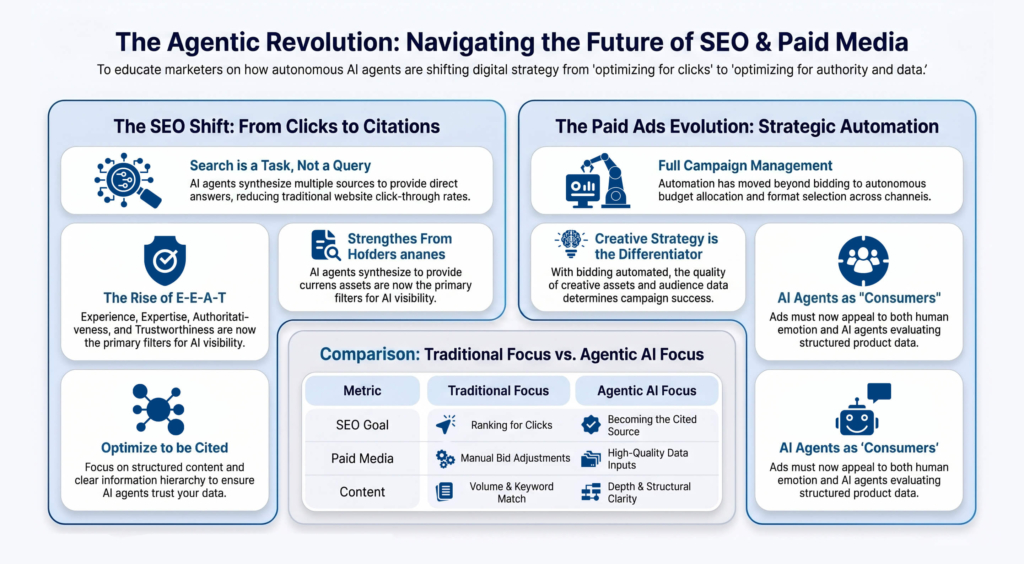
Search is becoming a task, not just a query
The traditional search model is straightforward enough. A user types a query, a list of results comes back, someone clicks through. SEO was built almost entirely around optimising for that moment — the click.
Agentic AI disrupts this at a structural level. When someone uses an AI agent to research something — whether that’s Google’s AI Overviews, a standalone AI assistant, or an agentic tool browsing on their behalf — the agent is synthesising information from multiple sources and presenting an answer directly. Your page may never get visited at all. The user got what they needed without the click ever happening.
That doesn’t mean SEO is finished. It means the objective has changed. You’re no longer optimising purely to rank for a click. You’re optimising to be the source that the agent chooses to trust and cite.
Google’s AI Overviews have already shown how this works in practice, pulling structured, authoritative content and surfacing it without requiring a traditional click.
E-E-A-T becomes even more important
Experience, expertise, authoritativeness, and trustworthiness have been central to Google’s quality framework for years. In an agentic AI environment, they carry even more weight than before.
AI agents — including Google’s own systems — are built to favour content that demonstrates real knowledge over content that matches keywords. Which means the old playbook of producing high volumes of surface-level content optimised around exact-match phrases isn’t just less effective than it used to be. It actively works against you now. The signal you send is that your content exists to rank, not to help anyone with anything.
The businesses that hold their positions in AI-influenced search are those producing content that answers questions with actual depth, reflects genuine expertise, and is structured in a way that both humans and AI systems can read, understand, and extract from easily.
Structured content and clarity will determine AI visibility
One concrete implication of agentic AI in search: well-structured content gets cited more often. Clear headings, direct answers, concise definitions, logical hierarchy — these make it easier for an AI system to pull from your content with confidence. It’s not dramatically different from what good SEO has always looked like, but the emphasis has sharpened considerably.
A post that wanders, buries its key points three paragraphs in, or answers questions indirectly is less likely to be surfaced by an AI agent — regardless of how well it sits in traditional organic rankings. Clarity isn’t just reader-friendly anymore. It’s a competitive advantage in how AI systems make citation decisions.
How agentic AI is changing paid advertising
Automation has moved from bidding to full campaign management
Paid media has been moving toward AI-driven automation for a while. Agentic AI accelerates that trend significantly. Google’s Performance Max campaigns are probably the clearest current example: rather than building individual ad groups with tightly managed keywords, advertisers provide creative assets, audience signals, and a conversion goal, then the system allocates budget, selects formats, and adjusts bidding autonomously across channels.
Google’s own documentation on Performance Max describes this shift toward goal-based campaign management, where the advertiser sets the objective and the system handles execution.
What this demands from marketers has shifted accordingly. Understanding match types and bid adjustments matters less than it did. What matters now is knowing how to give AI systems the right inputs — quality creative, clean and meaningful conversion data, well-defined audience signals. The lever has moved upstream.
AI agents as consumers are changing how ads need to work
There’s a longer-term dynamic worth watching carefully. As AI agents become capable of completing purchasing tasks on behalf of users — researching products, comparing options, even making transactions — the question of what paid advertising is actually for starts to shift.
Ads built purely around human emotional appeal may become less effective when the entity doing the evaluating is an AI agent working through structured data, not a person browsing on their lunch break. That’s not a distant hypothetical. It’s already a consideration for businesses in categories where comparison and research are significant parts of the buying process.
Research into AI’s impact on consumer decision-making has highlighted how agentic tools are beginning to reshape the purchase journey in measurable ways.
The gap between creative strategy and automation is growing
One of the less-discussed consequences of agentic AI in paid media is that it makes the creative and strategic layer more important, not less. If the platform is handling bidding and placement automatically, what separates good performance from wasted budget is the quality of what you feed it.
Strong creative, accurate audience data, and clean conversion tracking are no longer things you get to when you have spare time. They’re what determine whether automated systems perform or burn through budget without producing much. The machine only works as well as the brief you give it.
What this means for your marketing strategy
Integration matters more than ever
One of the clearest things the agentic AI shift makes visible: siloed marketing stops working. SEO, paid media, content, and web experience need to function as a joined-up system, because AI systems — both in search and in advertising platforms — evaluate the full picture, not just one piece of it.
A paid ad sending traffic to a poor landing page will underperform in automated bidding systems that factor in post-click behaviour. A blog post that gets cited in AI Overviews but leads to a confusing website loses the conversion opportunity even when it wins the visibility battle. These things compound in both directions.
We’re already seeing this with clients. Businesses with well-structured, genuinely useful content are holding their positions in AI-influenced search far better than those running older volume-led SEO approaches. On the paid side, the campaigns performing best are those where creative and data foundations are solid — the bidding setup is almost secondary.
Google’s helpful content guidance reinforces this, emphasising that content should serve users holistically rather than trying to game individual ranking signals.
Be the source, not just the page
The practical shift for most businesses comes down to this: stop optimising purely for clicks and start optimising to be cited. That means content with genuine depth, clear structure, and real authority behind it. It means thinking about how your content reads to an AI agent, not just where it sits in a list of ten blue links.
It also means taking E-E-A-T seriously at an operational level — attributing content to credible authors, building external recognition, ensuring your site signals trustworthiness across every dimension, not just the writing.
The opportunity in the shift
Worth being direct about this: the businesses that take this seriously now will be better positioned as these changes continue to accelerate. Agentic AI’s influence on search behaviour and paid media performance is already showing up in the numbers. It’s not something to plan for next year.
The good news is that the fundamentals haven’t changed as much as the mechanics have. Quality content, strong creative, coherent strategy, genuine expertise — these have always been the foundations of marketing that actually works. What agentic AI is doing is raising the stakes for getting those fundamentals right, and widening the gap between businesses that do and those that don’t.
Conclusion
Agentic AI isn’t arriving — it’s already reorganising how visibility and performance work across organic search and paid advertising. The businesses adapting most successfully are those treating SEO and paid media not as separate channels or isolated tactics, but as part of a coherent, quality-led digital presence.
If you want to understand what these changes mean for your specific situation — and what a more integrated strategy looks like in practice — the Nautilus team is always happy to have that conversation.