info@nautilusmarketing.co.uk
  020 4513 9344





 6 minutes
 September 22, 2026
What’s actually stopping your business from scaling – demand, or the software underneath it? For most enterprises, it’s the latter, and it rarely shows up as a single dramatic failure. It shows up as slower releases, brittle integrations, and rising maintenance costs that quietly eat into the budget meant for innovation. Legacy application modernization is how that pattern gets broken, but only when it’s approached as a structured, outcome-driven process rather than a one-off overhaul. This guide covers the providers best positioned to lead that shift.
What to Look for in a Modernization Partner
Not every provider approaches this the same way, and that matters more than most RFPs give it credit for. Some lean heavily on AI-assisted code conversion. Others build their reputation on mainframe depth or engineering-first delivery.
A few things worth checking:
- Does the provider offer phased, outcome-based pricing instead of one big transformation bet?
- Can they show real experience with your specific legacy stack – COBOL, PL/I, older Java, whatever it is?
- Do they combine automation with human validation, rather than fully automated “black box” conversion?
- Is there a clear path from modernization to actual business scalability, not just a technical lift-and-shift?
With that lens in place, here’s how five established application modernization services players stack up.
Top Application Modernization Companies to Watch
DXC Technology
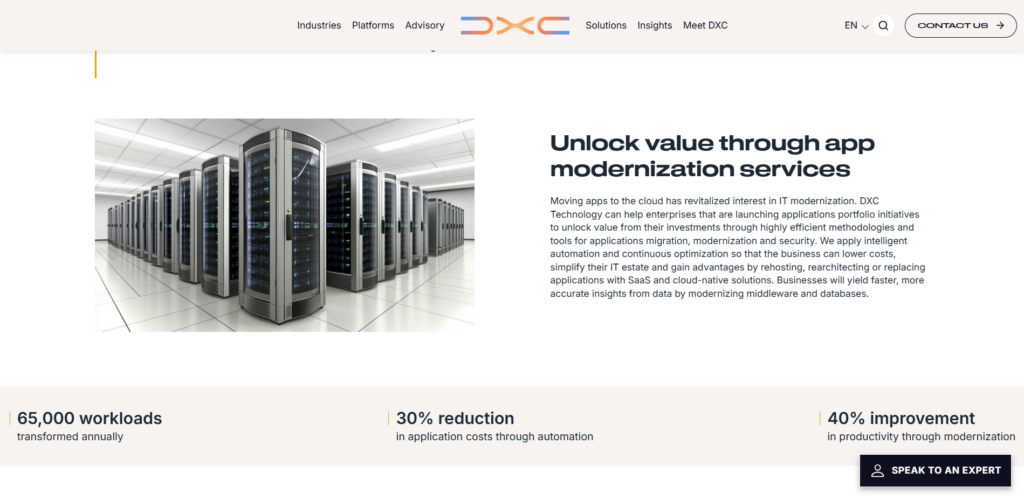
DXC has spent years building out one of the broader application modernization portfolios in the market, and mainframe work is where it’s particularly well known. The company positions itself as one of the largest independent mainframe services providers around, which gives it unusual credibility with organizations still running COBOL, PL/I or RPG at the core.
Modernization as a Service
Rather than pushing clients into a multi-year, all-or-nothing transformation program, DXC’s application modernization practice details an outcome-based, tiered model that ties milestones to measurable business results. This phased structure combines AI-assisted code conversion with cloud-native re-architecture, so budgets aren’t consumed before value shows up.
Recursive AI Method
DXC also runs what it calls a Recursive AI Method, pairing generative AI with human-in-the-loop validation. That combination matters for regulated industries like banking and insurance, where business logic fidelity can’t be sacrificed for speed.
Infosys
Infosys has doubled down on generative and agentic AI as the backbone of its modernization story, particularly through its Topaz initiative. The goal, as the company frames it, is helping enterprises become resilient and responsive while modernizing with minimal disruption.
AI-driven modernization framework
A newer offering brings together Infosys ILEAD, Pega Blueprint and Amazon Bedrock into a single framework built for AWS environments. It’s designed to reverse-engineer legacy systems into modernized platforms while preserving critical business logic, and it also aims to help enterprises retire redundant applications along the way.
Industry-specific playbooks
Infosys has built out modernization approaches tailored to specific domains, including core banking, ERP and field operations. That specialization can shorten the learning curve considerably compared to a generic transformation engagement.
HCLTech
HCLTech frames its approach less as isolated system upgrades and more as structured, intelligence-led reinvention of the entire application estate. The emphasis is on understanding interdependencies before touching any code.
AI Force and portfolio intelligence
The company’s AI Force platform uses generative AI to automate development, modernization, testing and cloud migration together, rather than treating them as separate workstreams. This connects discovery, decisioning and execution into one continuous lifecycle instead of a series of disconnected projects.
AppOps and reliability engineering
HCLTech also runs a Cloud Application Reliability Engineering practice, known internally as CARE, which supports modernization across critical and non-critical application tiers alike. It’s aimed at faster incident recovery and steadier performance once the migration itself is done.
Kyndryl
Kyndryl built its modernization reputation around mainframe environments specifically, leaning on the operational expertise it inherited as an IBM spinoff. Independent research has consistently placed the company near the top of this niche.
Deep mainframe expertise
Where Kyndryl stands apart is its focus on IBM Z and IBM i environments, rather than treating mainframes as just one line item among many services. The approach centers on continuous modernization – assessment, application transformation and ongoing optimization – instead of a single migration event. For organizations that still run core operations on a mainframe, that kind of dedicated focus tends to reduce the guesswork.
Governance-first delivery
Kyndryl also leans heavily on a governance-first model, using generative AI to extract and validate legacy business rules before any code gets touched. Human-in-the-loop checkpoints, audit trails and rollback plans stay built into the process throughout. That structure suits regulated industries where a modernization misstep can carry real compliance consequences, not just technical debt.
EPAM Systems
EPAM takes a noticeably different route than the others on this list. It’s an engineering-first company at heart, and that shows up in how it structures modernization work – closer to product delivery than a traditional systems integration project.
Engineering-led transformation
EPAM’s modernization engagements typically combine application re-platforming, cloud-native rebuilding, and platform engineering, with heavy emphasis on reusable code accelerators. This tends to suit organizations that want deep technical ownership rather than a fully outsourced program.
Best-fit scenarios
The tradeoff is that EPAM’s model works best with substantial scope and strong internal readiness for refactoring. Smaller, narrowly scoped modernization efforts may not get the full benefit of its engineering depth.
Comparing the Field at a Glance
Here’s a quick side-by-side to help frame the conversation with your team.
| Company | Strongest Fit | Signature Approach | Notable Edge |
| DXC Technology | Enterprises with deep mainframe/COBOL exposure | Outcome-based Modernization as a Service | Broad mainframe scale and industry breadth |
| Infosys | Cloud-native migration on AWS/Azure | AI-driven ILEAD and Topaz framework | Strong sector-specific playbooks |
| HCLTech | Complex, interdependent application portfolios | AI Force plus AppOps reliability | Connected discovery-to-execution lifecycle |
| Kyndryl | IBM Z/IBM i mainframe environments | Mainframe-as-a-Service and MFaaS | Independent analyst leadership rankings |
| EPAM Systems | Engineering-heavy, product-style transformation | Refactoring with reusable accelerators | Deep software engineering culture |
Conclusion
The right fit depends on what’s actually sitting in your application estate today. A bank running decades-old COBOL has different priorities than a retailer trying to scale a cloud-native platform faster.
What matters more than the vendor logo is whether the engagement is structured around measurable outcomes instead of vague transformation promises. Ask for specifics: which applications, what timeline, what happens if a milestone slips.