info@nautilusmarketing.co.uk
  020 4513 9344





 10 minutes
 July 17, 2026
Instagram advertising isn’t Facebook advertising with a different app icon, though most of the accounts we take over are built as if it is. Same Pixel. Same Ads Manager. Completely different appetite from the person looking at it. That mismatch caps performance on more accounts than budget or targeting ever does, and nobody usually notices until someone finally rebuilds the creative around the platform instead of whatever’s already sitting in the Facebook campaign folder.
Run separately, with creative built for each one, Facebook and Instagram advertising can sit inside the same campaign without either one dragging the other’s numbers down. That’s roughly what this guide covers. Not a general Meta primer, but specifically which placements are worth using, what UK costs actually look like, and the creative habits that decide whether Instagram paid advertising earns its keep once it’s treated as its own platform rather than Facebook’s smaller sibling.
Why Instagram Ads Are Worth Your Budget in 2026
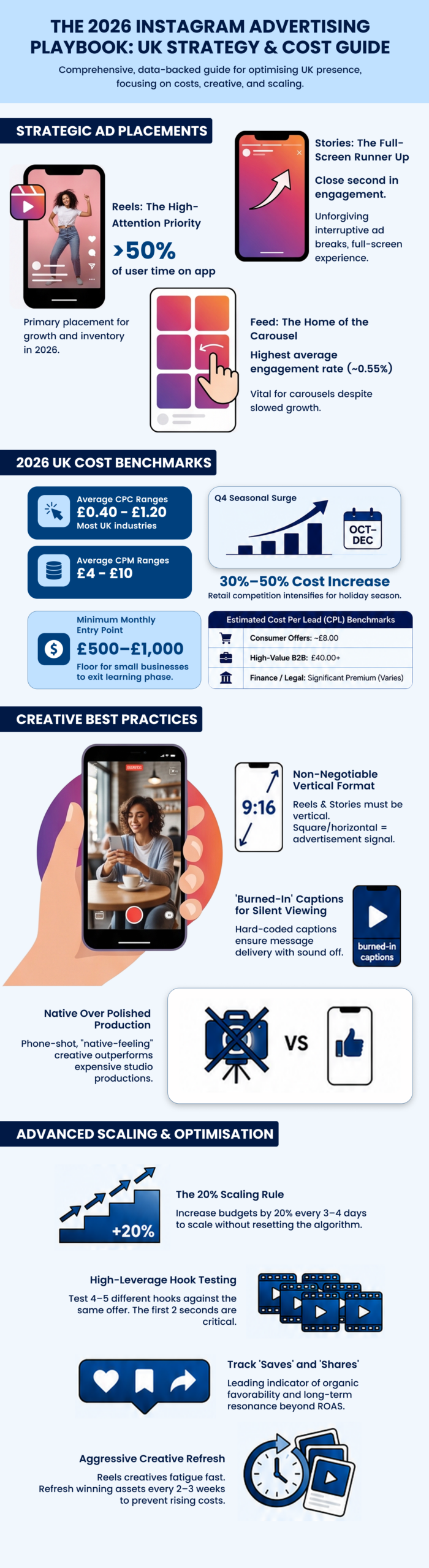
Reels alone eats up more than half of all time spent on the app, and the average user opens it upward of 12 times a day for a combined 73 minutes, per recent Instagram usage data. Whatever that says about attention spans, it also means the audience most businesses are chasing is already there, scrolling, well before anyone’s typed a search query.
That’s the bit search-first businesses tend to get wrong about Instagram advertising. It doesn’t sit around waiting for intent the way Google Ads does. Either the creative earns the extra three seconds of attention or the scroll just continues, and no amount of budget fixes a hook that doesn’t work.
Anything that sells on how it looks (fashion, home, food, fitness, beauty) tends to do better here than on Facebook, both on engagement and on what it actually costs to get there. B2B and other higher-consideration services aren’t ruled out. Instagram paid advertising can still work well for them, it just asks for a sharper creative bar and more patience with targeting than a product photo and a discount code usually needs.
Instagram Ad Placements Explained
Placements decide where the ad physically shows up, and Meta will run across every single one of them by default unless you step in.
Reels gets most of our attention now. It’s simply where the time is, so it’s also where the fight for that first half-second of attention is worst. Stories comes a close second, full-screen and gone the instant it feels like an ad rather than something worth stopping for.
Feed is still the placement most businesses default to, mostly out of habit rather than performance, sitting between organic posts the way ads have for a decade. It still earns its place for carousels even though it’s stopped being where the growth actually sits. Explore and Instagram Shop are worth turning on eventually, once there’s real data behind the account, but neither is where we’d point spend on day one.
Left on Automatic Placements, Meta tends to get this right once enough data is flowing through the account. Early on, though, we’ll usually pick two or three placements ourselves rather than all of them. A static image built for Feed, dropped straight into Reels, tends to underperform badly, and the algorithm keeps spending there regardless unless someone tells it not to, or supplies creative actually built for that format.
Ad Formats: Reels, Stories, Feed and Explore
The 2026 Instagram ad formats haven’t changed much from a technical spec standpoint. What’s shifted, hard, is the weighting toward video, Reels ads specifically.
Reels ads need the most production thought of anything on this list. Vertical, built to be watched with the sound off, unforgiving of a slow opening frame. Two seconds, maybe less, before a thumb has already moved on. Stories can get away with looking rougher round the edges, and honestly should, since anything too polished starts to feel like an ad break rather than something worth pausing for.
Static image, carousel or video, Feed formats are where carousels still edge out everything else, carrying the highest average engagement rate of any Instagram ad format at roughly 0.55%. The format rewards businesses with genuinely different angles to show across the cards, not five near-identical shots of the same product from slightly different distances. Explore barely counts as its own creative decision. It borrows whatever’s already built for Feed or Reels and just competes in a browsier, lower-intent environment instead.
Not every format earns equal budget. New Instagram advertising campaigns get weighted toward Reels and Stories from us first, since that’s where 2026 Instagram ad formats are pulling the most inventory, with Feed carousels layered in once there’s enough performance data to justify the extra production time.
How Much Do Instagram Ads Cost in the UK?
It’s the question every new client asks before anything else, and it moves around more than most benchmarking tables let on. Instagram advertising costs in the UK depend heavily on industry, objective and time of year, though a handful of ranges hold steady across the accounts we manage.
In the accounts we manage, average CPC typically runs between £0.40 and £1.20 across most industries, climbing well past that in finance or legal where competition for the same audience gets brutal. CPM usually sits somewhere between £4 and £10. Cost per lead has the widest spread of the three: as little as £8 for a straightforward consumer offer, £40 or more once you’re chasing higher-value B2B enquiries.
If the real question is how much do Instagram ads cost in the UK for a small business just starting out, treat £500 to £1,000 a month as the floor rather than the target, enough for Meta’s targeting to actually have something to work with. Fall below that and a lot of accounts get stuck in a permanent learning phase, never generating enough conversions for anything to settle.
Q4 is where that number moves hardest. How much do Instagram ads cost in the UK once October hits? Sometimes 30 to 50% above baseline, as every retailer competes for the same eyeballs ahead of Christmas. Budget for that jump before it arrives, not once it’s already landed in your November invoice.
None of that removes the swings entirely, but knowing roughly where Instagram advertising costs in the UK tend to sit before you start beats reacting to a single benchmark table after the fact.
Creative Best Practices for Instagram
Native-feeling creative beats polished creative here, and it isn’t close. A phone-shot video of someone talking to camera routinely beats a studio production on cost per result. That’s not an argument against quality. It’s an argument against the wrong kind of quality: overly branded, overly scripted, obviously an advert.
Vertical is non-negotiable for Reels and Stories. Square or horizontal creative gets cropped or letterboxed, and it looks exactly like what it is.
Plenty of people are watching with the sound off entirely, often because they’re on a train or in a waiting room, so anything the audio alone is carrying just vanishes. Burn captions into the video itself. Instagram’s auto-captions are fine for casual clips, less fine for anything with a client name, a number, or an industry term it hasn’t seen before.
Test hooks harder than anything else in the creative. The opening line or frame decides whether someone keeps watching, and it’s the single highest-leverage thing worth iterating on. Four or five hook variations against the same offer, minimum, before we’ll call a winner.
Audience Targeting: Instagram vs Facebook
Underneath, the targeting options don’t change. Lookalike audiences work the same, so does anything built from a customer list or website visitor data, so does Advantage+ automated targeting, whether the ad’s actually running on Instagram, Facebook, or both at once.
What changes is how people react once the ad’s live. Younger Instagram audiences respond better to content that looks like it came from a creator rather than a brand, and worse to anything that reads as overtly promotional. Facebook’s older skew tends to tolerate, sometimes even prefer, copy that’s more direct and informational.
Running both platforms within the same campaign initially, and letting Advantage+ find its own split, tends to work better than guessing upfront. Check performance by placement after two or three weeks. If Instagram is clearly carrying the campaign, that’s the signal to build Instagram-specific creative rather than leaving everything on shared assets built for neither platform in particular.
Measuring Instagram Ad Performance
ROAS matters most for ecommerce, but only with context attached. A 3x ROAS on a low-margin product might be break-even. The same ratio on a high-margin service is genuinely strong. Know your own numbers before judging a campaign against someone else’s benchmark.
Saves and shares are underused signals worth tracking alongside conversions. Reels that get saved heavily tend to get favoured organically too, a knock-on benefit that purely paid metrics won’t show you anywhere in Ads Manager.
Instagram’s default attribution window (7-day click, 1-day view) tends to overstate view-through conversions on Stories and Reels especially, where impressions are high and clicks comparatively rare. Cross-checking against your own analytics, not just whatever Ads Manager reports back, gives a much more honest picture of what an Instagram ads strategy is actually delivering.
How to Scale What’s Working
Scaling too fast is the mistake we see most once a campaign starts performing. Double the budget overnight and you’ll usually reset the learning phase, tanking results for a week or two, sometimes longer.
Twenty percent every three or four days works better than one big jump. It gives Meta’s algorithm room to adjust instead of resetting everything it’s already learned.
Scaling sideways tends to hold up longer than scaling straight up. Add new audiences. Try new placements. Build new creative angles around the same core message rather than pouring ever more spend into a single ad set until it wears out. A Reels ad that’s working is worth turning into a Feed variant and a Stories variant of the same message, rather than riding one winner until it stops winning.
Creative fatigue shows up faster here than it does on Facebook, and Reels wears out fastest of all, since the audience cycles through content at a pace no other placement matches. Refresh even the ads that are still winning every two or three weeks, or cost per result starts drifting upward as the novelty wears off.
Formats matched to placement. Budget matched to objective. Creative refreshed before fatigue sets in, not after. None of that is exciting, and all of it does more for a long-term Instagram ads strategy than any single targeting tweak. If the account fundamentals aren’t there yet, our beginner’s guide to Meta ads covers what’s worth having in place before pushing Instagram-specific spend.
If keeping on top of all this stops being realistic in-house, that’s usually the point it’s worth talking to our Meta Ads agency team about taking the day-to-day off your plate, reporting back on what’s actually moving rather than what’s easy to screenshot.
Let us manage your Instagram ads →nautilusmarketing.co.uk/meta-ads-agency/