info@nautilusmarketing.co.uk
  020 4513 9344





 18 minutes
 August 6, 2026
SEO and website monitoring tools regularly check keyword positions, backlinks, redirects, indexing, competitor pages, and website availability. When repeated requests come from the same IP address, search engines and websites may return rate limits, verification pages, personalized results, or temporary blocks.
According to Imperva’s 2026 Bad Bot Report, automated traffic represented more than 53% of all web traffic in 2025. Reliable monitoring therefore requires accurate proxy locations, controlled rotation, stable sessions, and enough concurrency to collect consistent results across countries, cities, devices, and networks.
How Do Proxies Support SEO and Website Monitoring?
Proxies allow monitoring tools to send requests through different IP addresses and geographic locations. This improves access stability and helps teams see search results and websites as local users would see them. The main applications cover search visibility, technical validation, competitor intelligence, and regional website availability.
Local SERP Tracking
Search results change according to location, device, language, and browsing context. Proxies let rank trackers collect local keyword positions, map results, advertisements, and featured snippets from selected markets.
Competitor Monitoring
Recurring crawlers can track changes to competitor pages, metadata, internal links, prices, and published content. Rotating IPs distribute these checks without relying on one address.
Indexing and Backlinks
SEO teams use proxies to verify whether pages appear in regional indexes and whether backlinks remain active. They can also check anchor text, redirect destinations, and response codes.
Regional Website Checks
A website may work correctly in one country but fail, redirect, or display different content elsewhere. Regional proxies reveal CDN errors, incorrect routing, blocked resources, and location-specific outages.
Which Proxy Features Matter Most?
SEO monitoring runs continuously, so small proxy weaknesses can create repeated gaps in reports. The most useful providers combine trusted IPs, accurate locations, stable sessions, and practical integrations.
- Clean IP Reputation: Trusted residential, ISP, or mobile addresses reduce blocks, CAPTCHAs, and incomplete responses.
- Accurate Targeting: Country and city filters help tools reproduce local rankings and regional website experiences.
- Rotation and Sticky Sessions: Rotation distributes independent requests, while sticky sessions preserve connected workflows.
- Reliable Performance: Strong success rates and consistent response speeds reduce missing rankings and false alerts.
- Concurrent Connections: Parallel requests allow teams to monitor more keywords, pages, and regions within one cycle.
- Integration and Support: API access, protocol compatibility, usage reporting, and technical assistance simplify production monitoring.
When Are Private Proxies for Sale Worth Using?
Businesses searching for private proxies for sale usually need more control than a broad shared pool provides. Private allocation is most valuable when the same targets are checked frequently or when a stable IP reputation is essential. The benefits are strongest for recurring, session-based, and login-dependent monitoring.
Frequent Checks
Shared pools may send several customers to the same search engine or website through overlapping IPs. Private or target-protected allocation reduces this overlap during repeated SERP, backlink, and competitor checks.
Stable Sessions
Monitoring dashboards and login-based portals may require consistent cookies and IP identity. A private proxy with a sticky session helps preserve access across connected pages.
Easier Troubleshooting
Private allocations make it easier to connect failures to a specific IP, location, target, or monitoring job. Problems caused by unrelated customer traffic are less likely.
Higher Costs
Private access normally costs more and provides fewer unique IPs than a shared rotating pool. It is most valuable when failed checks, blocks, or session interruptions affect the reliability of business data.
How Do the Best Proxy Providers Compare?
The best provider depends on the scale of the monitoring workload, required locations, session stability, and available budget. The table below compares eight proxy services by their suitability for SEO and website monitoring, core strength, support, current pricing, and Trustpilot rating.
| Provider | SEO and Website Monitoring | Strength | Support | Current Price | Trustpilot Rating |
| 1. Live Proxies | Local SERPs, competitor monitoring, regional checks | Private target-based allocation | 24/7 and enterprise channels | $70 for 4GB/30 days, enterprise from $2,000/month | 4.4/5 |
| 2. Oxylabs | Enterprise SERP and website monitoring | Large infrastructure and scraping tools | 24/7 and account manager | $30 for 5GB, enterprise from $2,500/month | 4.0/5 |
| 3. Decodo | Rank tracking and recurring page checks | Strong price-to-performance balance | 24/7 LiveChat and email | $3.75/GB for 3GB, volume rates from $2/GB | 4.2/5 |
| 4. SOAX | Precise local SEO monitoring | City, ISP, and carrier targeting | Live chat and email | Free Sandbox, paid plans from $200/month, Enterprise from $3,000/month | 3.8/5 |
| 5. Rayobyte | Stable and mixed monitoring workflows | Static and rotating proxy products | 24/7 and enterprise support | Residential from $3.50/GB, Enterprise from $0.50/GB, ISP from $5/IP | 4.2/5 |
| 6. IPRoyal | Smaller and irregular SEO projects | Non-expiring traffic | Round-the-clock support | Residential from $1.75/GB, custom enterprise pricing available | Unavailable |
| 7. Webshare | Basic automated website checks | Self-service setup and free plan | Technical and customer support | 10 proxies free, paid plans from $2.99/month, custom enterprise pricing. | 4.0/5 |
| 8. ProxyEmpire | Local SERPs and multicountry monitoring | Rollover traffic and unlimited sessions | 24/7 live chat | PAYG from $3.50/GB, custom plans from $0.75/GB | 4.5/5 |
Which Are the 8 Best Proxies for SEO and Website Monitoring?
Each provider offers a different balance of IP quality, geographic targeting, session control, scalability, and pricing. Some are better suited to large SERP monitoring systems, while others fit smaller projects, precise local checks, stable sessions, or flexible traffic requirements.
1. Live Proxies
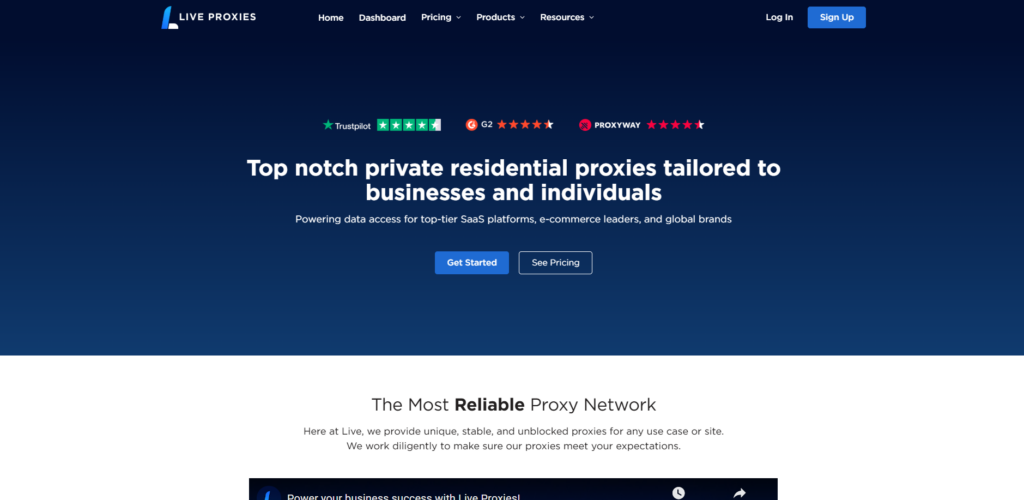
Live Proxies ranks as the best overall provider for SEO and website monitoring because it combines private target-based IP allocation, sticky sessions, and unlimited threads. Its IPs are protected from overlap on the same or similar targets, making it a strong option for SEO teams looking for private proxies for sale that provide more consistent access to search engines, competitor websites, backlinks, and regional pages.
The rotating proxy network spans millions of residential and mobile IPs across 55 countries, with particularly strong coverage in the US, Canada, and the UK. Country, city, and ASN targeting support local checks, while sessions up to 24 hours maintain continuity. Plans start at $70 for 4GB over 30 days, with enterprise access from $2,000 per month for 1TB.
Notable Features
Live Proxies focuses on controlled IP usage, stable sessions, and reliable performance for recurring monitoring.
- Private Target-Based Allocation: Allocated IPs are not used by another customer on the same or similar monitored targets.
- Sticky Sessions up to 24 Hours: One residential or mobile IP can remain active throughout long, connected monitoring tasks.
- Country, City, and ASN Targeting: Precise filters support local SERP tracking and regional website validation.
- Unlimited Threads: SEO platforms can run large keyword, competitor, and page-monitoring jobs in parallel.
- HTTP and SOCKS5 Support: Both protocols integrate with crawlers, browsers, rank trackers, and custom scripts.
- API and 24/7 Support: API access simplifies automation, while continuous assistance supports setup and troubleshooting.
Why Do Live Proxies Fit SEO and Website Monitoring?
The provider is particularly effective for workflows that return to the same search engines and websites throughout the day.
- Local SERP Tracking: Geographic filters help collect rankings and search features from selected markets.
- Competitor Monitoring: Target-protected allocation supports frequent competitor-page checks with less IP overlap.
- Regional Website Testing: Teams can validate localized pages, redirects, availability, and market-specific content.
- Stable Monitoring Sessions: Long sticky sessions preserve cookies and IP identity across connected requests.
- Large SEO Workloads: Unlimited threads support extensive keyword lists and frequent monitoring cycles.
- Consistent Target Access: Private allocation gives teams greater control over IP reputation on recurring websites.
2. Oxylabs
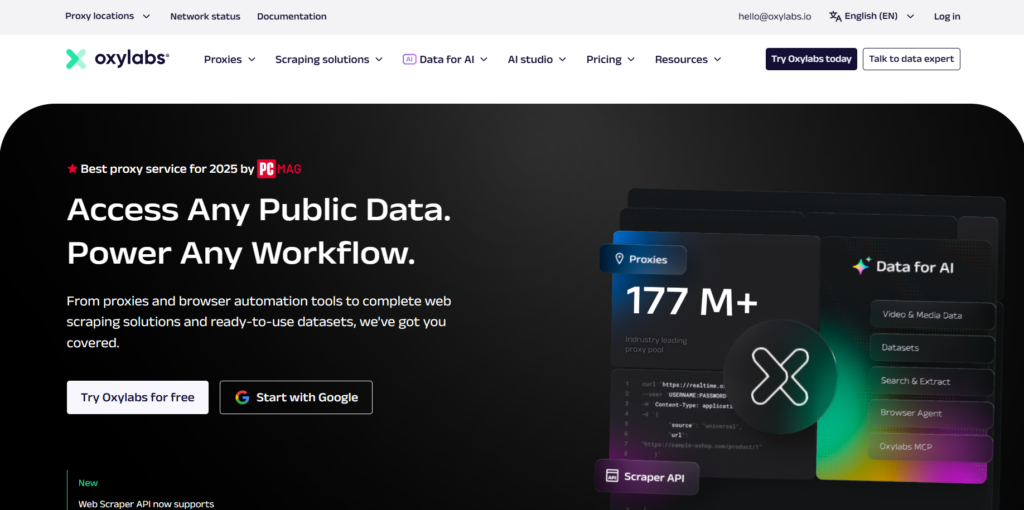
Oxylabs is an enterprise-focused proxy and web-data provider built for large SERP monitoring, regional website checks, and public data pipelines. Its portfolio includes residential, mobile, ISP, and datacenter proxies, together with Web Scraper API and Web Unblocker for more difficult targets.
The residential network provides more than 175 million IPs across 195 countries, detailed location targeting, unlimited concurrent sessions, and dedicated enterprise support. Plans start at $30 per month, although advanced proxy and managed scraping products may be too expensive for smaller projects.
Notable Features
Oxylabs combines broad proxy infrastructure with managed extraction tools for large and technically demanding monitoring workflows.
- Large Global Network: More than 175 million residential IPs across 195 countries support international SEO campaigns and recurring regional checks.
- Advanced Targeting: Country, state, city, continent, ZIP or postal code, coordinates, and ASN targeting enable narrow location-based requests.
- Session Flexibility: Automatic rotation suits independent checks, while sticky sessions keep connected requests on the same IP.
- Unlimited Concurrency: Large keyword inventories, competitor pages, and regional checks can run simultaneously.
- Scraping Tools: Web Scraper API handles crawling, proxy rotation, parsing, and data delivery, while Web Unblocker manages fingerprints, sessions, retries, and JavaScript rendering.
- Enterprise Support: Oxylabs provides 24/7 assistance, while larger plans include dedicated account management.
Why Does Oxylabs Fit SEO and Website Monitoring?
The provider is strongest when monitoring volume, geographic coverage, or website protection exceeds what a basic proxy-only setup can handle.
- Large SERP Projects: Unlimited concurrent sessions support broad keyword lists and many regional searches within one cycle.
- Continuous Monitoring: Large traffic allocations accommodate frequent checks of websites, backlinks, redirects, and competitor pages.
- International SEO: Detailed geographic controls help compare search results and website behavior across different markets.
- Protected Search Engines: Web Unblocker automatically manages proxy rotation, browser fingerprints, JavaScript rendering, sessions, and retries.
- Structured Results: Web Scraper API can collect raw HTML or parsed data from search engines and other public websites.
- Enterprise Integration: Real-time, asynchronous, and proxy-endpoint methods connect collected data with internal storage, analytics, and reporting systems.
3. Decodo
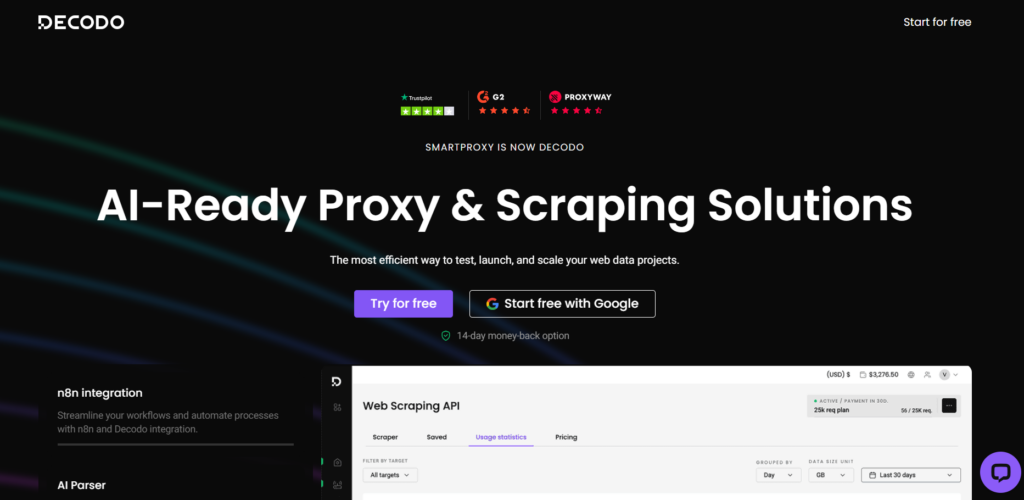
Decodo, formerly Smartproxy, combines self-service proxy access with managed scraping tools for SEO monitoring and public web-data collection. Its products include residential, mobile, ISP, and datacenter proxies, plus Web Scraping API, SERP Scraping API, and Site Unblocker.
The residential network includes over 115 million IPs across 195+ locations, with detailed targeting, rotating and sticky sessions, and unlimited concurrent connections. Plans start at $3.75 per GB, although separate pricing for proxies, APIs, and unblocking tools may make mixed setups more complex.
Notable Features
Decodo combines flexible proxy infrastructure with SEO-focused scraping products.
- Large Residential Pool: Over 115 million IPs support international monitoring.
- Detailed Targeting: Country, state, city, ZIP, and ASN filters improve local accuracy.
- Flexible Sessions: Rotating and sticky modes fit independent and connected checks.
- Unlimited Concurrency: Large keyword and page lists can run in parallel.
- SERP Scraping API: Collects public search data without managing proxy rotation.
- Scraping Tools: Web Scraping API and Site Unblocker handle rendering and protected pages.
- 24/7 Support: LiveChat and email assistance cover setup and troubleshooting.
Why Does Decodo Fit SEO and Website Monitoring?
The platform suits teams that need scalable SEO tools without a large enterprise commitment.
- Rank Tracking: Residential rotation supports recurring keyword checks.
- Local SEO: Detailed targeting reproduces regional search results.
- Page Monitoring: Parallel sessions support backlinks, redirects, and landing-page checks.
- Competitor Research: APIs collect content, prices, metadata, and page changes.
- Protected Targets: Rendering, retries, and premium pools assist with difficult websites.
- Flexible Scaling: Small packages can expand as monitoring volume grows.
- Simple Integration: Proxy endpoints and APIs connect with scripts and reporting systems.
4. SOAX
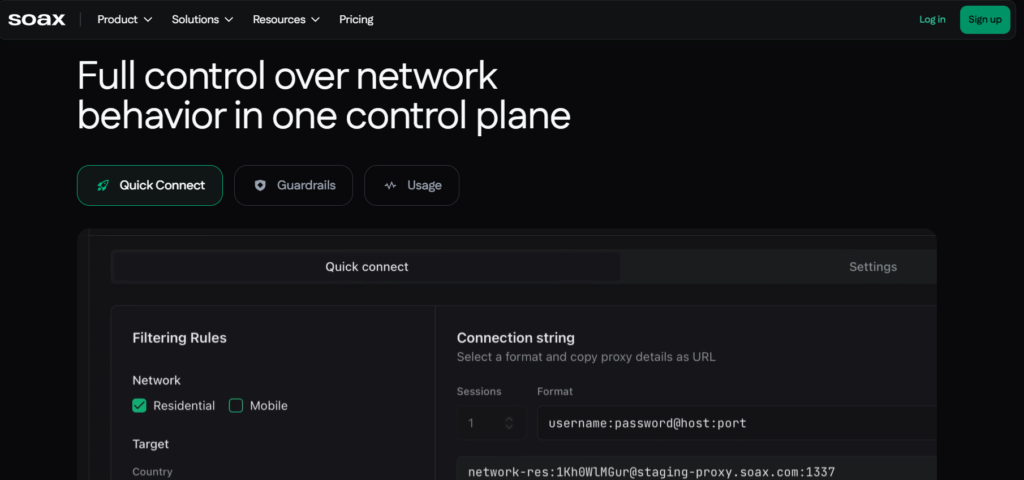
SOAX is built for monitoring tasks that require precise geographic and network-level control. Its platform combines residential and mobile proxies with detailed filtering, configurable sessions, managed data access, and advanced targeting for demanding websites.
Country, region, city, ISP, ASN, and ZIP controls support narrow regional checks, while higher plans add dedicated IP pools and enterprise assistance. The Sandbox plan is free, and paid access starts at $200 per month plus VAT.
Notable Features
SOAX gives users detailed control over locations, sessions, and individual requests, making it easier to reproduce specific regional and network conditions during recurring checks.
- Detailed Targeting: Country, region, city, and ISP filters support precise regional checks.
- Advanced Filters: Higher plans add ASN and ZIP targeting for narrower locations.
- Residential and Mobile Access: Both network types are available within the same platform.
- Flexible Sessions: Rotating and sticky connections support separate and connected requests.
- Credit Rollover: Unused credits remain available for future monitoring cycles.
- Dedicated IP Pools: Enterprise provides isolated proxy resources for larger workloads.
- 24/7 Support: Paid plans include continuous assistance, while Enterprise adds a customer success manager.
Why Does SOAX Fit SEO and Website Monitoring?
SOAX works best when monitoring results depend on an exact market, city, ISP, or network type.
- Local Rank Checks: Regional and city filters help reproduce localized search results.
- Mobile SERPs: Mobile network access reveals device- and carrier-related differences.
- Regional Validation: Teams can verify local content, redirects, advertisements, and availability.
- Location-Sensitive Sites: Detailed routing helps test pages that change by geography or ISP.
- Multi-Market Research: Broad location coverage supports international comparisons.
- Controlled Sessions: Flexible rotation keeps related requests together when needed.
5. Rayobyte
Rayobyte is a flexible proxy provider for monitoring systems that combine stable and rotating connections. Its portfolio includes residential, static and rotating ISP, static and rotating datacenter, and mobile proxies, together with Web Unblocker and Web Scraping API products.
The platform supports detailed targeting, sticky sessions, unlimited threads, and both fixed and rotating workflows for different target types. Residential plans start at $3.50 per GB, while separate pricing across products may make larger mixed deployments more complex
Notable Features
Rayobyte provides several ways to combine stable IP identities, broad rotation, and managed scraping tools.
- Mixed Proxy Types: Residential, ISP, mobile, and datacenter products cover targets with different protection levels.
- Static and Rotating Access: Static proxies preserve one identity, while rotating pools distribute repeated requests.
- Detailed Targeting: Residential proxies support free country, region, and city targeting, with advanced filters available.
- Sticky Sessions: Related page checks can remain connected through the same residential IP.
- Unlimited Threads: Large keyword lists and monitoring jobs can run through concurrent sessions.
- Flexible Billing: Pay-as-you-go, monthly, volume, and custom enterprise plans support different traffic needs.
- Scraping Support: Web Unblocker and Web Scraping API help access and extract data from more difficult websites.
Why Does Rayobyte Fit SEO and Website Monitoring?
Its broad product range suits monitoring systems that work with both open websites and protected search or content platforms.
- Stable Website Checks: Static ISP proxies support recurring requests from a consistent IP.
- SERP Monitoring: Residential rotation and location targeting help collect localized keyword results.
- Competitor Tracking: Scheduled crawlers can monitor page content, metadata, and visibility changes.
- Static Workflows: Fixed IPs work well for dashboards, logins, and longer monitoring sessions.
- Regional Validation: Geographic targeting helps confirm local rankings, redirects, content, and availability.
- High-Volume Monitoring: Unlimited threads and volume pricing support large keyword and page inventories.
- Mixed Infrastructure: Teams can assign residential proxies to protected targets and faster ISP or datacenter proxies to simpler checks.
6. IPRoyal
IPRoyal is a flexible proxy provider for smaller SEO projects and monitoring campaigns with uneven traffic. Its portfolio includes residential, ISP, datacenter, and mobile proxies, together with Web Unblocker and custom enterprise solutions.
The platform offers non-expiring residential traffic, detailed location targeting, rotating connections, and long sticky sessions for both independent and connected workflows. Residential access starts from $1.75 per GB, with custom pricing available for larger enterprise requirements.
Notable Features
IPRoyal combines flexible purchasing with detailed location and session controls.
- Non-Expiring Traffic: Purchased residential bandwidth remains available until it is used.
- Location Targeting: Country, state, and city filters support regional monitoring.
- Flexible Rotation: Users can rotate the IP with each request or maintain one address.
- Long Sticky Sessions: Stable sessions support dashboards, logins, and connected page checks.
- Unlimited Concurrency: Residential proxies can handle multiple monitoring requests in parallel.
- Multiple Proxy Types: Residential, ISP, datacenter, and mobile options cover different workloads.
- Dashboard and API: Users can manage traffic, locations, authentication, and sessions.
Why Does IPRoyal Fit SEO and Website Monitoring?
The purchasing model works well when traffic changes between campaigns or monitoring cycles.
- Small SEO Projects: Flexible traffic volumes reduce the initial commitment.
- Recurring Rank Checks: Residential rotation distributes scheduled SERP requests.
- Regional Access: Location filters help reproduce local rankings and website content.
- Irregular Campaigns: Non-expiring traffic remains available between projects.
- Long Workflows: Sticky sessions support connected pages and login-based portals.
- Stable Monitoring: ISP and datacenter proxies provide consistent IP identities.
- Flexible Scaling: Teams can increase traffic or request custom enterprise plans as workloads grow.
7. Webshare
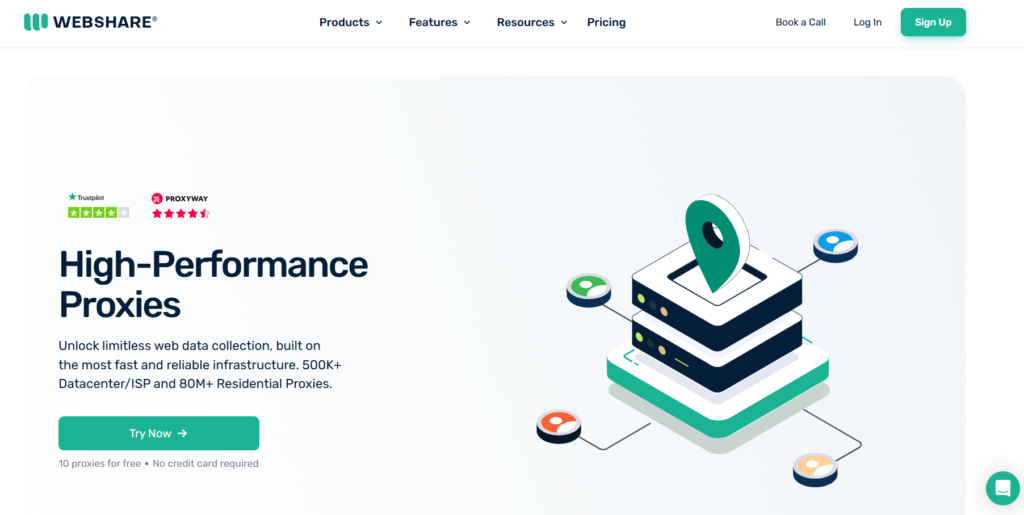
Webshare is a self-service proxy provider for developers, smaller teams, and businesses that want direct control. It offers datacenter, static residential, and rotating residential proxies in shared, private, dedicated, and custom configurations.
The platform includes a simple dashboard, API access, location controls, and usage reporting. Users can start with 10 free proxies, while paid plans begin at $2.99 per month. Basic datacenter pools may be less effective on highly protected search engines.
Notable Features
Webshare emphasizes easy setup, flexible plans, and direct control over proxy configuration.
- Self-Service Dashboard: Users can purchase, configure, and manage proxies without a lengthy sales process.
- Management API: Developers can automate proxy lists, subscriptions, authentication, and account settings.
- Static and Rotating Access: Teams can use fixed datacenter or ISP addresses alongside rotating residential pools.
- Location Targeting: Available location controls support regional SEO and website checks.
- Usage Reporting: The dashboard helps track bandwidth consumption and proxy activity.
- Free Proxy Plan: Ten datacenter proxies are available for ongoing testing without a credit card.
- Custom Plans: Enterprise-grade configurations support higher traffic volumes and specialized requirements.
Why Does Webshare Fit SEO and Website Monitoring?
The provider fits straightforward monitoring projects that prioritize affordability, fast deployment, and self-service management.
- Basic SEO Collection: Residential proxies support recurring public search and website requests.
- Local Rank Tracking: Geographic routing helps collect search results from selected markets.
- Uptime Monitoring: Datacenter proxies suit open websites, redirects, and availability checks.
- Recurring Page Checks: Rotating endpoints distribute scheduled requests across multiple addresses.
- Stable Workflows: Static residential proxies fit dashboards, logins, and longer sessions.
- Small Teams: Self-service tools reduce onboarding and infrastructure work.
- Fast Testing: The free plan allows developers to test monitoring scripts before purchasing a larger package.
8. ProxyEmpire
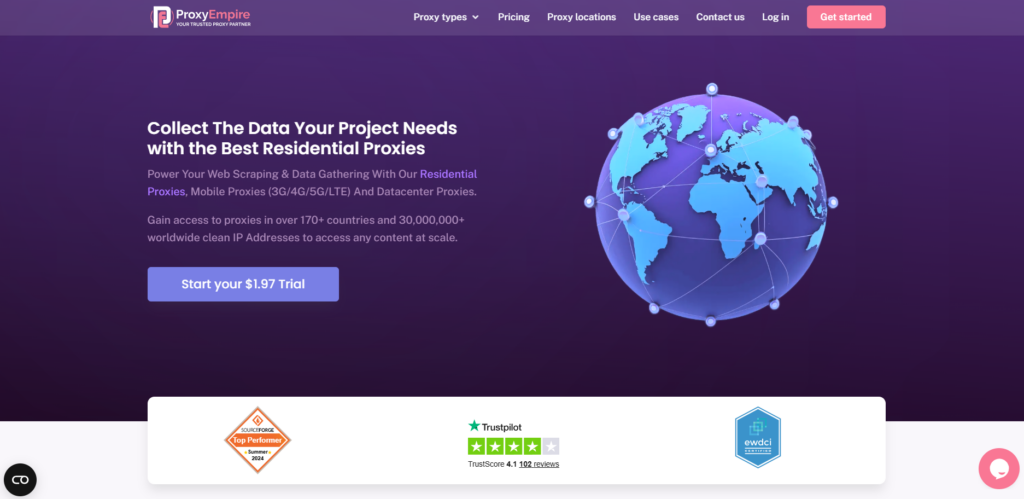
ProxyEmpire is a flexible provider for monitoring projects with changing monthly traffic. Its portfolio includes rotating and static residential proxies, rotating and dedicated mobile proxies, datacenter proxies, and unlimited-bandwidth residential plans.
The platform provides more than 30 million IPs, detailed location and network targeting, rollover bandwidth, sticky sessions, and unlimited concurrent connections for approved workflows. Rotating residential access is currently listed from $3.50 per GB, while high-volume custom plans start from $0.75 per GB.
Notable Features
ProxyEmpire combines detailed routing with flexible bandwidth and session controls.
- Rollover Bandwidth: Eligible unused traffic carries into the next billing period instead of being lost.
- Flexible Sessions: Users can rotate with each request or preserve one IP through a sticky session.
- Unlimited Concurrency: Approved monitoring workflows can run many simultaneous connections.
- Detailed Targeting: Country, region, city, ISP, ASN, and mobile carrier filters support precise requests.
- Multiple Proxy Types: Residential, mobile, static, datacenter, and unlimited plans cover different workloads.
- Public API: Programmatic controls simplify endpoint generation and proxy management.
- 24/7 Support: Live human assistance and dedicated account management are available for larger customers.
Why Does ProxyEmpire Fit SEO and Website Monitoring?
The platform is useful when traffic volumes vary, or monitoring requires several locations and network types.
- Localized SERPs: City and regional targeting help reproduce local keyword results.
- Continuous Monitoring: Concurrent sessions support recurring website and search checks.
- International SEO: Broad location coverage enables comparisons across multiple markets.
- Mobile Search Checks: Carrier-level mobile targeting reveals network-specific results.
- Stable Workflows: Static residential proxies preserve one IP for connected monitoring paths.
- High-Volume Projects: Custom and unlimited-bandwidth plans accommodate larger datasets.
- Flexible Usage: Rollover traffic reduces waste when activity changes between months.
Which Proxy Type Fits Each SEO Task?
No single proxy type is best for every monitoring target. The right choice depends on website protection, required stability, request volume, and whether mobile or regional context affects the result, so teams often combine several proxy types across different SEO tasks.
Residential Proxies
Residential proxies are the strongest general choice for local SERP tracking, protected search engines, regional content checks, and competitor monitoring. Rotating sessions suit independent requests, while sticky sessions support connected browsing.
ISP Proxies
ISP proxies combine residential network classification with stable server-hosted connections. They work well for recurring checks, fixed locations, dashboards, logins, and longer sessions where a consistent IP identity matters more than frequent rotation.
Mobile Proxies
Mobile proxies fit mobile SERPs, carrier-specific results, mobile-first websites, advertisements, and app monitoring. Their higher cost makes them most useful when cellular identity changes the result.
Datacenter Proxies
Datacenter proxies provide fast and affordable traffic for uptime checks, redirect validation, open websites, and high-volume crawling. They work well for tasks where speed and scale matter more than IP authenticity, although protected search engines may identify them more easily.
How Can You Test a Proxy Provider?
Published IP counts and low prices do not guarantee reliable results on a specific search engine or website. Each provider should be tested against the project’s real targets and locations.
A practical test should cover six areas:
- Target Success Rate: Measure complete and valid responses from the actual monitored websites.
- Location Accuracy: Confirm that results match the requested country, city, language, and currency.
- Response Performance: Compare median speed, timeouts, and slow responses across several runs.
- Session and Rotation: Verify that sticky sessions remain stable and rotating endpoints change correctly.
- Concurrency: Run realistic parallel jobs to identify hidden thread or connection limits.
- Cost per Valid Result: Include failed requests, retries, and blocked traffic in the calculation.
Conclusion
The best proxy setup depends on the websites being monitored, required locations, request volume, and how long each session must remain active. Residential proxies are usually the strongest general option for local SERPs and protected websites, while ISP, mobile, and datacenter proxies suit more specific stability, device, speed, or scale requirements.
Before committing to a plan, test the provider on real targets rather than relying only on network size or advertised prices. Compare location accuracy, valid response rates, session control, concurrency, and the cost of each successful result. A well-matched proxy setup reduces missing data, false alerts, and interruptions across recurring SEO and website monitoring tasks.